



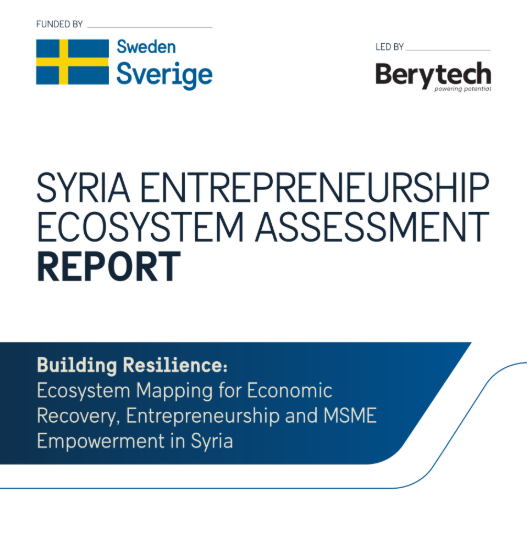
The new Syria Entrepreneurship Ecosystem Assessment Report, spearheaded by Berytech in partnership with Startup Syria and funded by the Swedish International Development Agency (Sida) , offers a comprehensive analysis of Micro, Small, and Medium Enterprises (MSMEs) and entrepreneurship in post-conflict Syria. Drawing on a nationwide survey of 143 respondents and over 40 key informant interviews, the study assesses how entrepreneurial activity, despite being fragmented and operating at minimal capacity, remains a critical pathway for resilience and economic recovery.
Chronic Funding Gap is the Single Most Urgent Barrier
Access to finance emerged as the most critical and widespread obstacle facing Syrian entrepreneurs. This is exacerbated by the dysfunction of the formal banking system and the absence of high-risk capital like Venture Capital (VC) and angel networks.
- Entrepreneurial Perspective: An overwhelming majority (77.1%) of MSME owners cited the difficulty in securing finance (grants, loans, or investment) as a critical unmet need. Furthermore, access to finance was ranked as the most “extremely challenging” issue by founders in the severity assessment.
- Alternative Finance Reliance: Due to these constraints, many entrepreneurs rely on informal mechanisms like remittances and hawala networks, or they register businesses abroad to access global financial systems, underscoring the limitations of the local financial environment.
- Expert Consensus: Ecosystem support organizations strongly concurred, with 80.6% identifying access to finance and investment as the most critical need for the ecosystem.
Infrastructure Decay and Legal Ambiguity Compound Challenges
Beyond finance, poor infrastructure and an outdated regulatory framework were consistently highlighted as major systemic barriers.
- Infrastructure: Limited access to electricity, internet, transportation, and water severely hampers productivity and service delivery across all sectors. Poor infrastructure was rated as “extremely challenging” by 40% of founders.
- Legal Hurdles: Complex, outdated, and vague laws make business registration and compliance difficult, particularly for innovative startups. Legal and regulatory restrictions were deemed “extremely challenging” by another 40% of respondents.
- Ecosystem Fragmentation: The support ecosystem is highly fragmented, with stakeholders operating in silos and minimal coordination between incubators, universities, and banks. Only 14.3% of entrepreneurs reported receiving support from an NGO or development program, and a mere 1% from a government entity.
ICT Leads Maturity as Green Sectors Lag
The analysis provided a critical snapshot of entrepreneurial maturity across key sectors.
- ICT and Digital Services lead in both volume (41.96% of surveyed businesses) and maturity, showing a presence across all business stages, including some established startups. Despite this, the sector still faces severe constraints from poor internet connectivity and lack of IP protection.
- Agrifood, Renewable Energy, and Circular Economy ventures remain largely underdeveloped beyond the conceptual or early-stage phases. The Renewable Energy sector, in particular, faces the most severe combination of challenges, with nearly all barriers scoring above 4 out of 5 in difficulty. Experts, however, emphasized the high potential of these sectors for job creation, food security, and climate resilience.
Strategic Recommendations for Recovery
The report concludes with a set of shared and author-driven strategic recommendations for donors and implementing partners to catalyze recovery.
- Capital Innovation: Expand access to capital by adopting alternative, de-risked financial models such as equity-free seed funding, revenue-based financing, and donor-matched grants.
- Sectoral Focus: Develop sector-specific programs targeting agritech, renewable energy, and digital services, acknowledging regional needs (e.g., support for trade/agrifood in Aleppo, clean energy in Homs, and digital services in Damascus).
- Diaspora Engagement: Create structured platforms to engage the Syrian diaspora for long-term mentorship, skills transfer, and investment, moving beyond fragmented, personal contacts.
- Support System Reform: Shift training from short, generic programs to experiential, long-term mentorship and practical incubation models.
About Berytech and Startup Syria
Berytech is an internationally certified entrepreneurship support organization founded in 2002. It focuses on facilitating the inception and growth of innovative businesses, leveraging its expertise in mapping ecosystems and implementing high-impact entrepreneurship programs across the region.
Startup Syria is a founder-focused organization established in 2013 to support founders start and scale their ventures. It actively engages with both the local Syrian entrepreneurship community and the Syrian diaspora, advocating for better access to funding and more favorable laws to enable startups to lead the way in rebuilding a new Syria.