




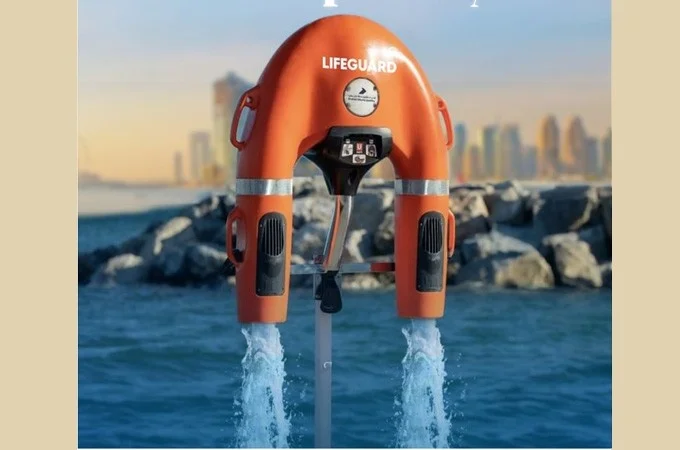
Dubai Municipality has launched an integrated AI-enabled beach safety system across its public coastlines, marking a regional first for aquatic rescue operations. The new framework combines aerial water-rescue drones with the U SAFE aquatic robot, significantly accelerating emergency response times and reducing risks for human lifeguard teams across the emirate.
Quick Facts
- Robot travels five times faster than human swimmers.
- Remote device safely tows up to 500 kilograms.
- System covers all five public beaches in Dubai.
Upgrading Dubai Coastal Rescue Operations
Beach safety remains a persistent challenge across the Gulf due to year-round coastal activity and high volumes of transient visitors. To address this, Dubai has restructured its initial rescue response model. Instead of relying solely on physical interventions, lifeguards now deploy the U SAFE aquatic rescue robot.
Developed and manufactured in Portugal by Noras Performance, the remote-controlled, self-propelled device operates at a range of up to one kilometre within a line of sight.
The robot features a U-shaped hull and twin turbine design, allowing it to function normally regardless of which side faces up. This capability makes it highly effective in rough seas and rocky coastal conditions where traditional rescue vessels and human swimmers face severe physical risks.
The U SAFE hardware was previously recognized as a CES 2023 Innovation Awards Honoree in the Human Security for All category, selected from more than 2,100 global applications.
Integrating Aerial Drones for Real-Time Threat Detection
Operating alongside the aquatic robot, Dubai Public Beaches introduced a water rescue drone that functions as a deployable flying lifebuoy.
The aerial drone can rapidly reach individuals in distress, land directly on the sea surface, and provide immediate buoyancy support. Equipped with a live-feed camera, the drone streams real-time visuals back to lifeguard teams stationed on the shore.
This continuous aerial monitoring allows for faster incident detection, accurate risk assessment, and tightly coordinated rescue operations across complex coastal areas.
According to Bader Anwahi, Chief Executive Officer of the Public Facilities Agency, this integration of robotics and aerial units introduces a high level of operational precision, combining speed and intelligence to protect beachgoers.
About Dubai Municipality’s Beach Safety Initiative
Dubai Municipality manages public beaches and canals across the emirate, including Umm Suqeim 1 Night Beach, Jumeirah 1, Jumeirah 2, Jumeirah 3 Night Beach, and Al Mamzar. The new AI-powered deployment covers all five of these heavily trafficked coastal zones. The initiative represents a deliberate shift toward proactive coastal safety management, supported by trained lifeguard teams and centralized control systems designed to handle complex or time-critical aquatic emergencies.
Source: Middle East AI News