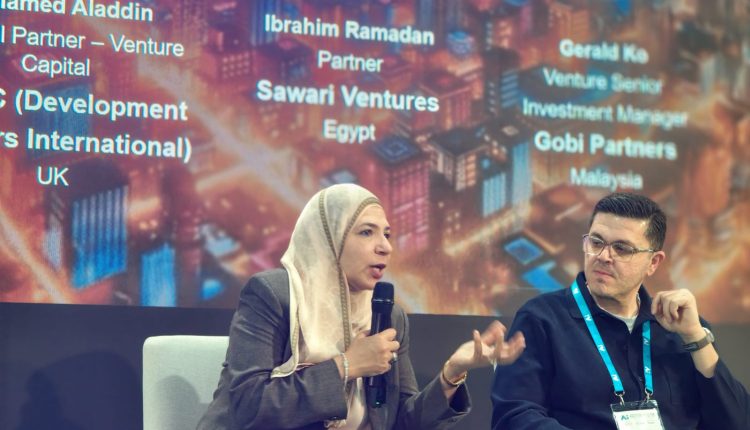





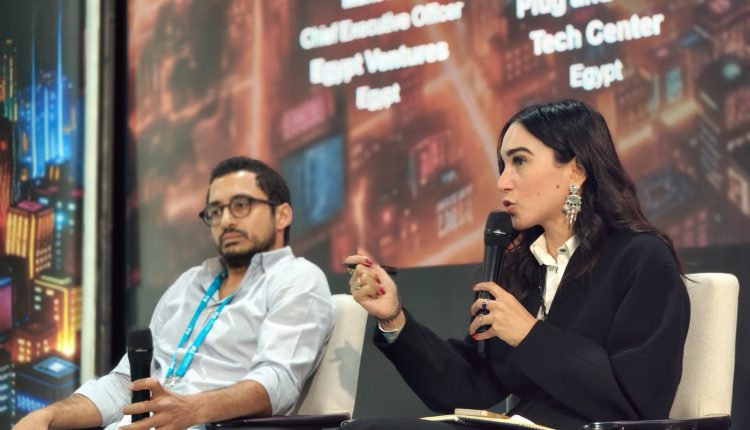
At the AI EVERYTHING summit in Cairo, Karima El Hakim, Regional Director of Plug and Play, outlined a clear vision for Egypt’s technological future, emphasizing that the next stage of economic growth depends on systematically connecting small and medium-sized enterprises (SMEs) with artificial intelligence applications. El Hakim argued for an integrated ecosystem model to ensure AI innovations translate into tangible economic value.
The Five-Party Innovation Model
El Hakim stressed that building a robust AI ecosystem is a collaborative effort, not the responsibility of a single entity. She introduced her “Five-Party Model,” which calls for professional coordination between five key stakeholders: governments, large corporations, investors, academic institutions, and entrepreneurs. This framework, she noted, was developed from research conducted during her eight-month fellowship at the Massachusetts Institute of Technology (MIT), which focused on bridging the gap between academic research and commercial application.
From Academia to Commercial Viability
Highlighting the potential within universities, El Hakim discussed the launch of an AI center of excellence in collaboration with major corporations to transform academic innovations into market-ready products. She pointed out that while academic institutions are capable of developing advanced solutions, the primary challenge lies in equipping researchers, particularly PhD holders, with the entrepreneurial skills needed to build scalable businesses. This is where investors play a critical role, providing essential early-stage funding and support.
SMEs as the Real Economic Fuel
According to El Hakim, the “real fuel” for Egypt’s upcoming growth phase is its vast base of medium-sized companies poised for expansion. She asserted that beyond its skilled technical talent, Egypt’s strength lies in these established enterprises. The immediate priority is to facilitate the practical and strategic adoption of AI within these companies once they have met foundational regulatory and technical requirements. The opportunity, she explained, is less about founding new startups and more about the widespread, practical application of AI within existing productive sectors like logistics, healthcare, construction, and energy management.
The Missing Link in Digital Transformation
The missing link in the current digital transformation landscape, El Hakim explained, is the strategic integration of the SME economy with the AI economy. Achieving this synergy would dramatically expand the user base for advanced tech services. It would allow specialized AI companies to reach a larger pool of clients, moving beyond the limited segment of large corporations that can currently afford high-end solutions. However, she cautioned that investing in AI requires a significant financial and organizational commitment to cover the high costs of specialized talent, infrastructure, and robust legal and cybersecurity frameworks.
Beyond Technology Deep Domain Expertise
El Hakim concluded with a critical piece of advice for founders: technology alone is insufficient for success. She emphasized the necessity for “deep domain expertise” to truly understand the challenges customers face. Without this in-depth industry knowledge, founders risk developing solutions for problems that don’t actually exist. On a national level, she noted that while creating a national AI strategy is a good step, the real value lies in its large-scale execution through projects that tangibly improve services and the daily lives of citizens.
About Plug and Play
Plug and Play is a global innovation platform connecting startups, corporations, venture capital firms, universities, and government agencies. Headquartered in Silicon Valley, it has a presence in over 50 locations across the globe, facilitating connections and investments to drive innovation forward.
Source: Fintech Gate