





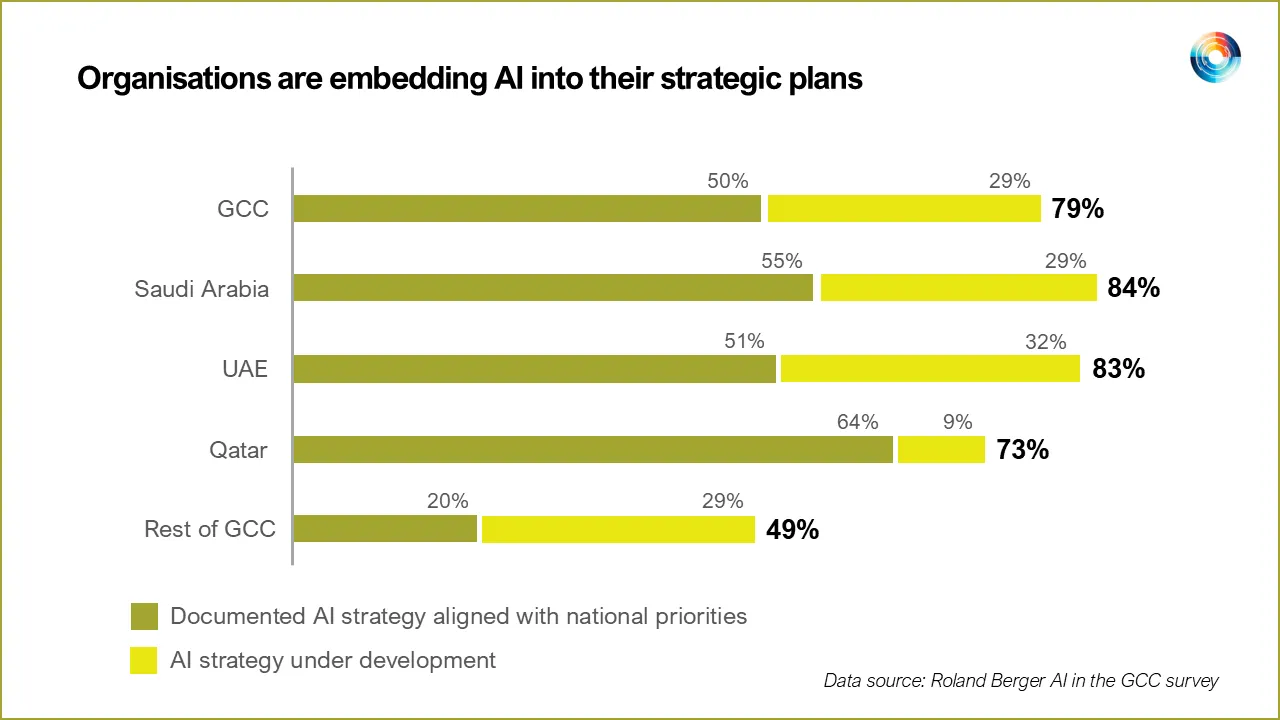
A new report from Roland Berger Middle East reveals a significant disconnect between artificial intelligence ambition and execution across the Gulf. The study, titled AI across the Gulf: From ambition to scalable impact, found that while nearly 80% of Gulf Cooperation Council (GCC) organisations have embedded AI into their strategic plans, most lack the operational foundations to deploy it at scale.
The Ambition Versus Execution Divide
The findings, based on insights from C-suite and director-level decision-makers, show a strong strategic commitment to AI, with 85% of organisations expecting their AI budgets to increase in 2026. Enhancing customer and citizen experience has emerged as the top priority, cited by 46% of respondents.
However, this strategic push is contrasted by a stark execution gap. The report highlights that only one-third of organisations have an enterprise-wide data strategy in place. Furthermore, fewer than one in three possess the necessary operating model and formal governance, such as dedicated AI ethics or compliance boards, required to effectively scale AI deployments.
Public Sector Leads The Charge
Driven by national mandates and ambitious digital government programmes, public sector organisations are advancing more rapidly than their private counterparts. The study found that over 90% of public sector entities have an AI strategy in place or under development, compared to just 75% in the private sector.
This government-led push is accelerating adoption and setting a benchmark for the region, viewing AI as a critical driver of tangible value through faster decision-making, new revenue opportunities, and stronger risk management.
Generative AI In The Spotlight
Generative AI has become the leading technology focus for 35% of respondents, valued for its immediate business impact, visible productivity gains, and relative ease of adoption. In response to a rapidly evolving landscape, many organisations are also shifting toward multi-vendor AI ecosystems to balance flexibility, performance, and compliance needs.
Overcoming Key Barriers to Scale
The report identifies several critical barriers hindering the transition from pilot projects to scaled implementation. Key challenges include persistent data quality issues, technology readiness gaps, limited funding beyond initial experiments, and weak cross-functional collaboration. A significant talent shortage, particularly in integrating AI into daily workflows, also remains a major obstacle.
To bridge the gap, Roland Berger outlines several key actions. These include conducting organisation-wide AI readiness assessments, translating high-level strategy into business-led roadmaps with clear ownership, strengthening data and technology foundations, and establishing cross-functional delivery teams supported by centralised AI Centres of Excellence.
About Roland Berger Middle East
Roland Berger is a global strategy consulting firm with a strong presence in the Middle East. The firm advises clients on a wide range of management issues, from strategy development to performance improvement, across various industries. Its research and insights, such as the AI across the Gulf report, provide critical data and analysis on the region’s evolving business and technology landscape.
Source: middleeastainews