
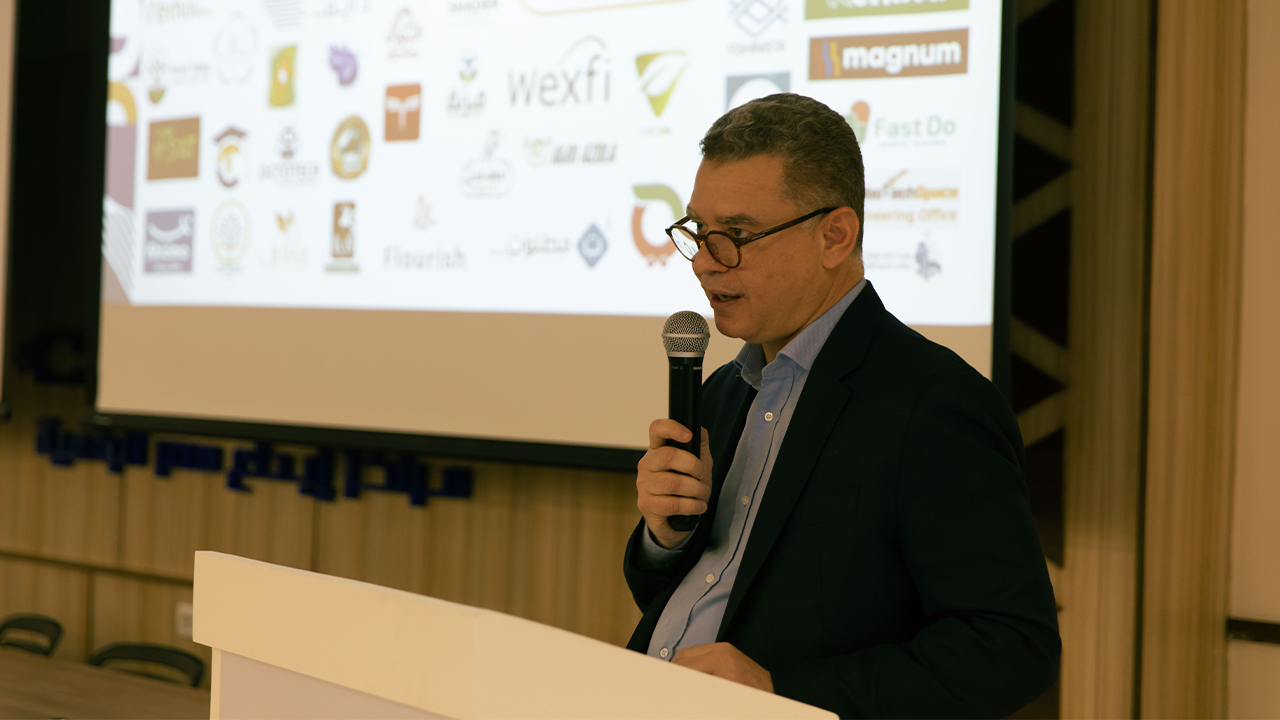

In a direct address to the region’s top investors and founders, Tareq Amin, CEO of HUMAIN, outlined a bold, execution-first strategy for artificial intelligence, revealing the inner workings of Saudi Arabia’s national AI company and its ambition to compete on a global scale. Speaking at the PIF Private Sector Forum 2026, Amin moved beyond the hype of AI pilots to detail a new operational blueprint designed for tangible results.
Amin began by citing a stark statistic from an MIT report: between 90 to 95 percent of generative AI pilots in enterprises are failing. He argued that this widespread failure is not a technological problem but a failure of vision and execution.
“This is a fact,” Amin stated. “And in my opinion, it is almost never about the technology. It is about mindset and execution.”
From Pilots to Performance
According to Amin, enterprises globally, from Saudi Arabia to the United States, are stumbling over the same three structural barriers. The first is a lack of clear business objectives, with many organizations deploying AI without defining the problem or measuring outcomes like productivity or revenue growth.
The second is poor data readiness. “Garbage in, garbage out,” Amin said, stressing the need for unified data platforms to support AI at scale. The third and most critical barrier is isolation. Amin warned that for AI to deliver value, it cannot remain a siloed experiment within IT departments; it must be deeply embedded into business workflows and owned by business leaders.
“AI is not another technology cycle,” Amin told the audience. “It is a game-changing revolution. But value comes only when you change the narrative from experimentation to execution.”
Building an AI-Native Enterprise
HUMAIN was established by consolidating AI capabilities and investments, including assets from Saudi Aramco and Aramco Digital, to create a global AI player. To achieve this, the company chose to reinvent its operating model from the ground up, creating what Amin calls an “AI-native company.”
At the heart of this model is a centralized AI agent orchestration platform known internally as “HUMAIN One.” This single interface gives employees access to over 150 AI agents that run various corporate functions. Amin revealed that employees operate without traditional desktop applications, instead using natural language to declare their intent.
“They see one interface,” he explained. “Why should you click on icons to execute tasks? You declare your intent.”
Whether in Arabic or English, employees can initiate research, manage projects, or execute administrative tasks, with the platform connecting AI models directly to core business systems.
Infrastructure as a Strategic Advantage
Amin detailed HUMAIN’s strategy across the full AI value chain, positioning infrastructure as a key competitive advantage. The foundation is HUMAIN Core, which consists of gigawatt-scale data center campuses built not just for domestic needs but to serve global AI workloads.
“AI is an energy game,” Amin said. “And Saudi Arabia has abundance in power, land, connectivity and water.”
He confirmed that global technology leaders including Amazon, Nvidia, AMD, Qualcomm, and xAI are already hosting or committing AI training and inference workloads on infrastructure within the Kingdom. This positions Saudi Arabia to become a major exporter of AI compute, a strategic evolution of its global energy leadership.
In parallel, HUMAIN is building proprietary frontier models designed to understand Saudi culture, language, and context, reducing reliance on generic open-source models.
Turning AI into Measurable ROI
To prove the model’s effectiveness, Amin shared internal case studies. In business travel management, HUMAIN One automated the entire process, from integrating HR policies to communicating with travel agencies. This eliminated approximately 65 hours of manual work and multiple full-time roles previously needed for coordination.
Payroll management saw even greater returns. By integrating with Saudi bank APIs and SWIFT systems, the AI platform automates payroll, conducts audits, and flags variances in real-time.
“This is a game changer,” Amin said. “Everything is auditable. Everything is automated.”
A Glimpse into a Saudi Operating System
Concluding his presentation, Amin revealed that Saudi Arabia is preparing to commercialize its own national operating system, a feat achieved only by the United States and China. He described the platform as AI-native, intent-driven, and agent-based, representing a fundamental shift from traditional systems like Windows or MacOS.
While further details are expected at an upcoming event, the announcement underscores HUMAIN’s ambition to architect the future of enterprise operations, moving decisively from abstract pilots to a fully reinvented, AI-driven reality.
About HUMAIN
HUMAIN is Saudi Arabia’s national company for artificial intelligence. It exists to build AI for good—for its clients, for its communities, and for the world.
Source: Zawya