



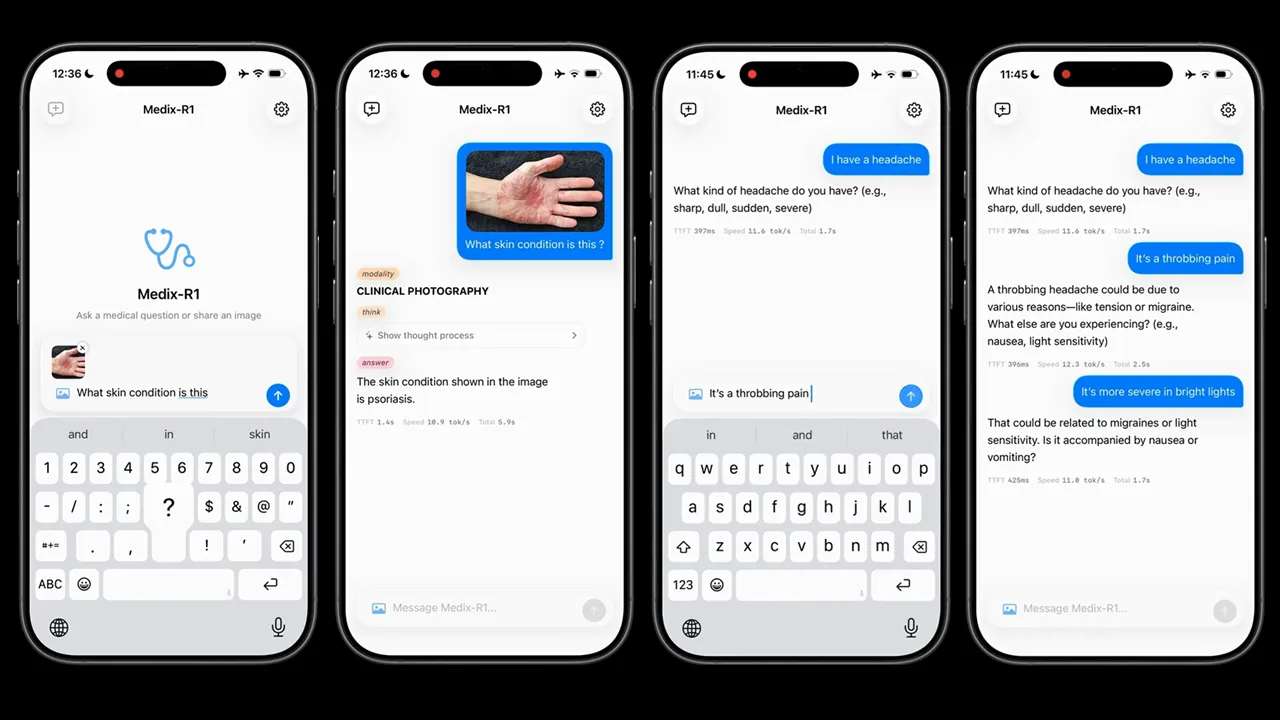
Researchers at Abu Dhabi’s Mohamed bin Zayed University of Artificial Intelligence (MBZUAI), in collaboration with medical doctors from India, have introduced MediX-R1, a groundbreaking open-source multimodal medical AI model. The new model leverages reinforcement learning to provide free-form clinical reasoning across 16 different medical imaging modalities, moving beyond the limitations of traditional multiple-choice AI systems.
The research, supported by an NVIDIA Academic Grant and an MBZUAI-IITD Research Collaboration Seed Grant, represents a significant step forward in making sophisticated medical AI more accessible, particularly in resource-constrained environments, by dramatically reducing the need for costly, large-scale human-annotated training data.
Beyond Multiple-Choice Reasoning
A major challenge in medical AI has been its reliance on multiple-choice question formats for training and evaluation. This method fails to capture the nuanced, open-ended reasoning required in real-world clinical practice.
MediX-R1 addresses this by using reinforcement learning with a carefully designed composite reward system. This allows the model to generate reliable and practical clinical responses without the extensive, expensive human annotation that has previously been a barrier to development.
Impressive Performance and Efficiency
MediX-R1 has demonstrated powerful capabilities, achieving a benchmark average of 73.6% across 17 medical datasets and an impressive 95.1% accuracy on the US Medical Licensing Examination. In blind expert reviews, doctors preferred the model’s responses 72.7% of the time.
Highlighting its efficiency, the model’s 8 billion parameter variant outperforms Google’s MedGemma-27B model, despite being approximately three times smaller. This efficiency is a direct result of the team’s innovative reinforcement learning approach.
Lowering Barriers to Medical AI
The MediX-R1 model was trained on a remarkably lean dataset of only 51,000 instruction examples. This data efficiency is enabled by a novel composite reward framework that combines multiple signals to stabilize learning and prevent errors.
The model is available in several sizes, with the 2 billion parameter version capable of running locally on a mobile device without an internet connection. This broadens potential access and application in lower-resource healthcare settings. MediX-R1 supports over 16 imaging modalities, including X-ray, CT, MRI, and ultrasound, making it one of the most versatile open-source medical vision-language models available today.
Open-Source for Broader Impact
The entire project—including model weights, training code, and datasets—has been fully open-sourced under a CC-BY-NC-SA 4.0 licence. This commitment to transparency allows the global research community to build upon this work.
The researchers note that MediX-R1 is currently a research prototype and is not intended for clinical deployment. Further evaluation, including fairness analysis and clinician-in-the-loop testing, is required before it can be considered for real-world medical use.
About MBZUAI
The Mohamed bin Zayed University of Artificial Intelligence (MBZUAI) is a graduate-level, research-based academic institution located in Abu Dhabi, United Arab Emirates. As the world’s first university dedicated solely to artificial intelligence, MBZUAI aims to empower students, businesses, and governments to advance AI as a global force for positive progress.
Source: Middle East AI News