




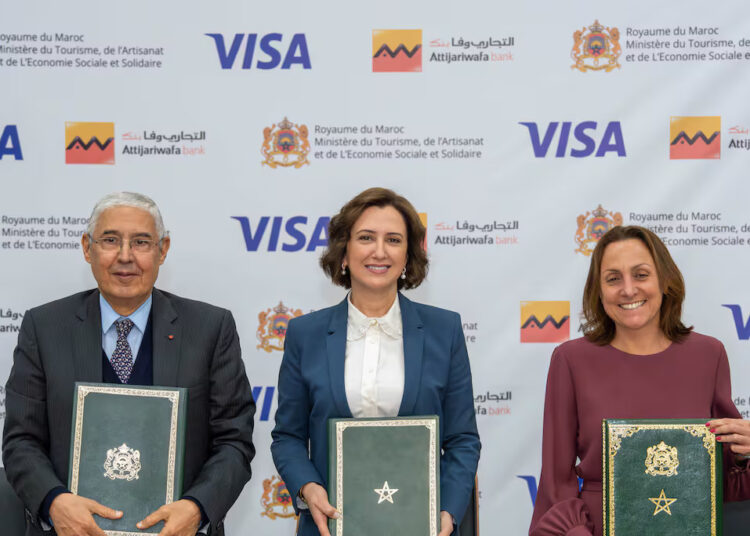
Morocco’s Ministry of Tourism, in a landmark partnership with Attijariwafa Bank and Visa, has launched the “Stay Cashless” program, a strategic initiative aimed at accelerating the adoption of digital payments across the country’s booming tourism sector. The agreement was formalized through a memorandum of understanding signed in Rabat.
The program is designed to modernize the payment experience for the millions of tourists visiting Morocco, providing them with secure, seamless, and globally accepted digital payment solutions.
Bridging the Gap in a Cash-Heavy Economy
While Morocco’s tourism sector is hitting record highs, generating MAD 138 billion in travel receipts and welcoming nearly 20 million visitors in 2025, its payment infrastructure has struggled to keep pace. Data from Bank Al-Maghrib reveals a heavy reliance on cash, with over 60% of card transactions in 2024 being ATM withdrawals and currency in circulation reaching approximately 26% of the nation’s GDP.
This disparity creates a frustrating experience for international visitors accustomed to cashless environments. The low density of Point-of-Sale (POS) terminals, particularly outside major hubs like Casablanca and Marrakech, forces tourists into a daily search for cash.
“The MAD 138 billion in travel receipts in 2025 show that Morocco has an attractive tourism offer,” said Tourism Minister Fatim-Zahra Ammor. “But expectations are evolving, and digital payment is becoming the norm. Moving toward cashless at scale is no longer an option.”
Targeting SMEs and Overcoming Adoption Hurdles
A key focus of the “Stay Cashless” initiative is to empower small and medium-sized tourism businesses (SMEs), which form the backbone of the sector. The program will offer practical tools like reduced international commissions, pay-by-link services, and tap-on-phone technology to bring smaller operators in line with global standards.
However, significant cultural and economic barriers remain. Many merchants avoid digital payments to keep transactions off the books, a common practice in an informal economy estimated at 30% of GDP. Others impose illegal surcharges or minimum payment amounts on card transactions due to high fees, creating a negative experience for tourists.
Hamid Bentahar, president of the National Tourism Confederation (CNT), emphasized the program’s dual approach. “It combines new, more adapted solutions with a training and awareness program to allow all operators, particularly SMEs, to improve their services and offer a smoother experience to visitors,” he explained.
Digital Readiness for the World Stage
The push for digitization is timed strategically as Morocco prepares to host mega-events, including the 2030 FIFA World Cup and the African Cup of Nations. These events are expected to attract a massive influx of international visitors who expect frictionless payment options for everything from transport to souvenirs.
Leila Serhan, Visa’s Group Country Manager for North Africa, the Levant, and Pakistan, framed the initiative as a catalyst for growth. “This tripartite partnership is not limited to technical collaboration – it is a growth engine that uses data and innovation to digitize the entire tourism value chain,” she said.
For Attijariwafa Bank, the partnership aligns with its broader mission. CEO Mohamed El Kettani stated, “Through this partnership, Attijariwafa Bank reaffirms its engagement to accompany key sectors of the Kingdom by mobilizing innovative, inclusive payment solutions aligned with international standards.”
About Stay Cashless
Stay Cashless is a national program launched by Morocco’s Ministry of Tourism, Attijariwafa Bank, and Visa. The initiative aims to accelerate digital payment adoption within the Moroccan tourism sector by providing SMEs with modern payment technologies, training, and awareness campaigns. Its goal is to create a seamless and secure payment experience for tourists, aligning Morocco’s infrastructure with global standards ahead of major international events.
Source: Morocco World News