



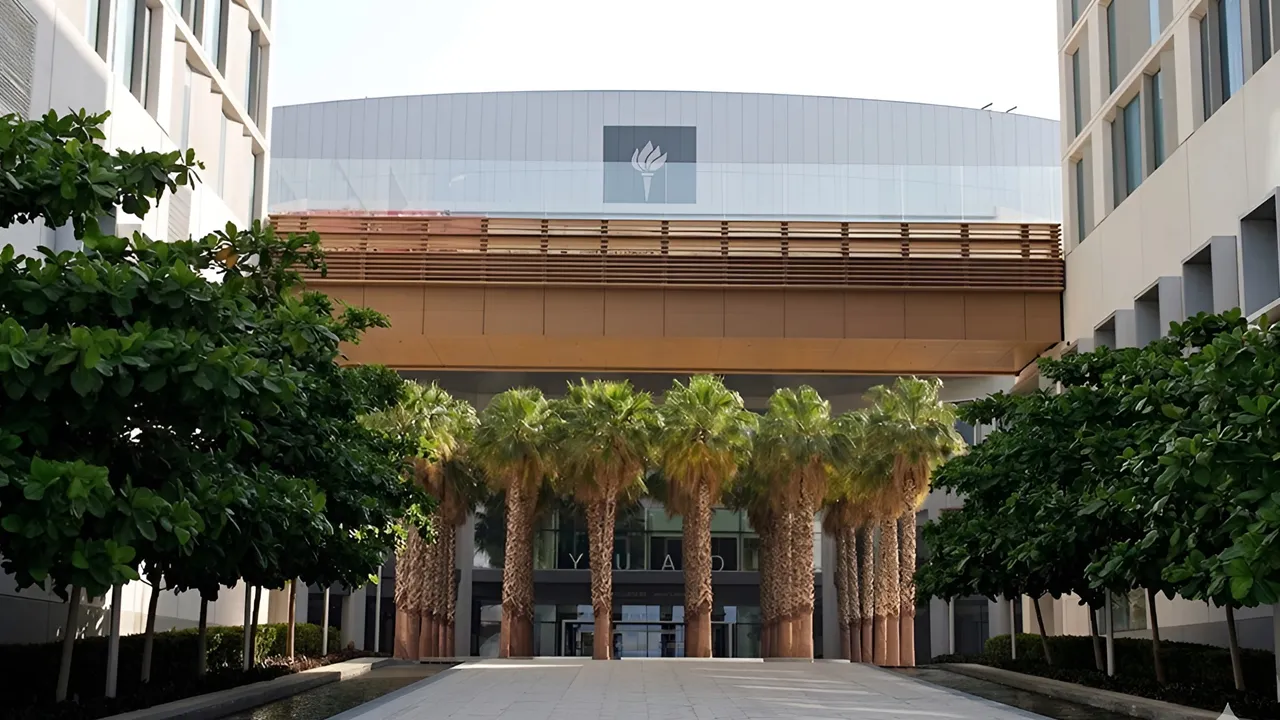
In a major milestone for artificial intelligence applied to deep science, researchers at NYU Abu Dhabi have demonstrated that AI can independently rediscover the foundational principles of particle physics. Relying entirely on raw experimental data from the 1950s and 1960s, the system achieved these results without any pre-programmed theoretical knowledge or mathematical bias.
Quick Facts
- Published in the Journal of High Energy Physics.
- Used raw 1950s data without prior theoretical input.
- AI independently identified fundamental Standard Model organizing principles.
Unsupervised Machine Learning Meets Quantum Physics
The study, titled “Rediscovering the Standard Model with AI,” reveals that relatively standard machine learning tools can uncover organizing principles that originally required decades of human effort to establish.
NYU Abu Dhabi researchers Aya Abdelhaq, Pellegrino Piantadosi, and Fernando Quevedo applied unsupervised machine learning to historical particle physics data. The team utilized principal component analysis, t-distributed stochastic neighbor embedding, and clustering algorithms.
Because the AI system was provided with zero theoretical context regarding the mathematical tools of the era, the depth of the physical structures it identified carries heavy significance for the future of data-driven scientific research.
Replicating the Standard Model from Scratch
The AI successfully identified the fundamental structures of the Standard Model. This quantum field theory, formalized between the 1960s and mid-1970s, classifies all known fundamental particles and describes the electromagnetic, weak, and strong interactions.
From the raw inputs, the algorithms autonomously deduced conserved quantities, including baryon number, isospin, strangeness, charm, and bottom quantum numbers.
The algorithms also reproduced the Eightfold Way, the classification scheme developed by American theoretical physicist Murray Gell-Mann in 1960. This theory grouped particles into structured families and ultimately paved the way for the discovery of quarks. Furthermore, the AI identified Regge trajectories—patterns linking a particle’s mass to its spin—strictly through pure data analysis.
This achievement mirrors previous scientific breakthroughs in chemistry, where researchers used unsupervised algorithms to reconstruct the periodic table of elements by analyzing atomic environments and chemical compounds.
Pushing the Boundaries of Deep Tech Science
The research team is exploring whether these algorithms can infer gauge symmetries from quantum field theory or recover quarks as the fundamental building blocks of hadrons.
The broader objective is to deploy AI to scan vast datasets for previously unrecognized patterns. By using systems that are not biased by existing theoretical frameworks, scientists hope to identify new physics and unknown particles outside the current Standard Model.
Navigating Regional Complexities
The publication of the study arrives as NYU Abu Dhabi manages regional operational challenges. The institution recently closed its Abu Dhabi campus temporarily due to associated Iran war risks, shifting its academic programs to remote formats.
University officials emphasized that the closure was a precautionary measure, prioritizing the safety of its faculty, staff, and international student body. The particle physics research was completed prior to these operational shifts, highlighting the institution’s sustained focus on advanced R&D.
About NYU Abu Dhabi
Opened in 2010, NYU Abu Dhabi is the highest globally ranked university in the UAE according to Times Higher Education, placing it among the top 31 universities worldwide. The institution serves a diverse student body of approximately 2,200 students representing roughly 120 countries, forming a core part of New York University’s global network alongside its campuses in New York and Shanghai.
Source: Middle East AI News