




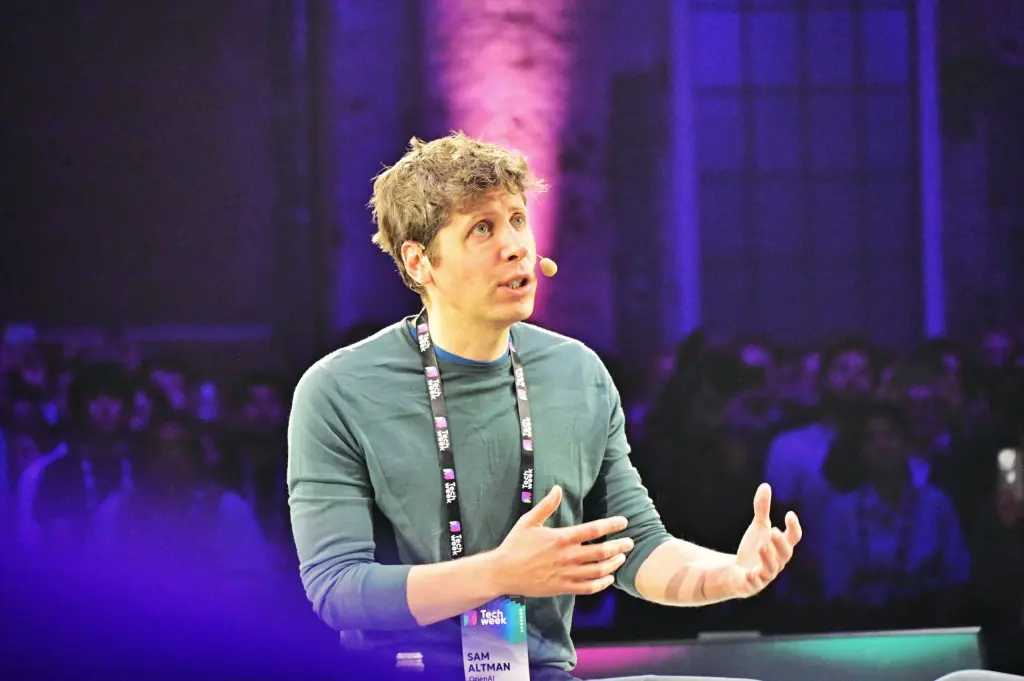
In a candid reflection on the competitive landscape of artificial intelligence, OpenAI CEO Sam Altman revealed that his company was in a “really bad place” in 2023, suggesting that tech giant Google could have easily “smashed” them. The reason they didn’t, according to Altman, lies in the classic innovator’s dilemma—a lesson that holds significant weight for both startups and established giants across the MENA region.
The Incumbent’s Trap
Altman believes OpenAI’s survival was less about its own technological superiority at the time and more a consequence of its competitor’s structural weaknesses. He points to Google’s immensely profitable business model as the very thing that made it slow to disrupt itself and fully commit to a new paradigm.
“Google has probably the greatest business model in the whole tech industry,” Altman argued. “And I think they will be slow to give that up.”
This hesitation provided the crucial window for OpenAI to establish itself, a moment of vulnerability that Altman acknowledged could have easily ended differently.
Mining the Capability Overhang
While competitors focus on building the next most powerful model, Altman is equally focused on what he terms the “overhang”—the vast, untapped gap between an AI model’s theoretical capabilities and how the world is currently using it.
“The overhang of the economic value that I believe [our model, version] 5.2 represents, relative to what the world has figured out how to get out of it so far, is so huge,” he stated.
This gap serves as a strategic safety net. It means OpenAI can continue driving significant revenue simply by helping users better leverage its existing technology, creating value even without groundbreaking new releases.
Compute as the Core Economic Engine
According to Altman, OpenAI’s primary growth constraint isn’t a lack of customers or a weak sales strategy, but a fundamental shortage of computing power. He views compute not as a cost center, but as a direct revenue-generating asset.
“We have never yet found a situation where we can’t really well monetize all the compute we have… if we had double the compute, we’d be at double the revenue right now,” Altman claimed.
This direct correlation means the company’s revenue growth closely tracks the expansion of its server fleet, keeping it in a constant state of “compute deficit.”
Building a Moat Through Personalization
To secure long-term loyalty, OpenAI’s strategy centers on personalization. Altman believes the key to making products indispensable is to create an AI assistant that learns and adapts to individual users over time, building a deep, personal connection that transcends model performance.
“In ChatGPT, for example, personalization is extremely sticky. People love the fact that the model gets to know them over time, and you’ll see us push on that much, much more,” he noted.
This focus on the consumer product has also created a powerful enterprise sales pipeline. The widespread familiarity with ChatGPT allows OpenAI to bypass traditional, lengthy sales cycles, as businesses are already acquainted with its core interface and capabilities.
Implications for the MENA Tech Ecosystem
Altman’s insights offer a powerful blueprint for the MENA startup scene. He champions the “AI-native advantage,” where new companies can outmaneuver incumbents by building their entire operations around AI from day one, rather than “bolting AI onto the existing way of doing things.” This presents a massive opportunity for agile MENA startups to disrupt legacy industries.
Conversely, his analysis serves as a warning to the region’s established giants in banking, telecommunications, and energy. Like Google, their current profitability could breed complacency, making them vulnerable to smaller, AI-first challengers who can operate with greater speed and innovation. The race for AI dominance in MENA will not just be about capital, but about the willingness to embrace foundational change—a classic battle between the incumbent and the innovator.
About OpenAI
OpenAI is an AI research and deployment company. Its mission is to ensure that artificial general intelligence (AGI)—AI systems that are generally smarter than humans—benefits all of humanity. The company is behind some of the world’s most advanced AI models, including the GPT series and the popular application ChatGPT.
Source: Tech in Asia