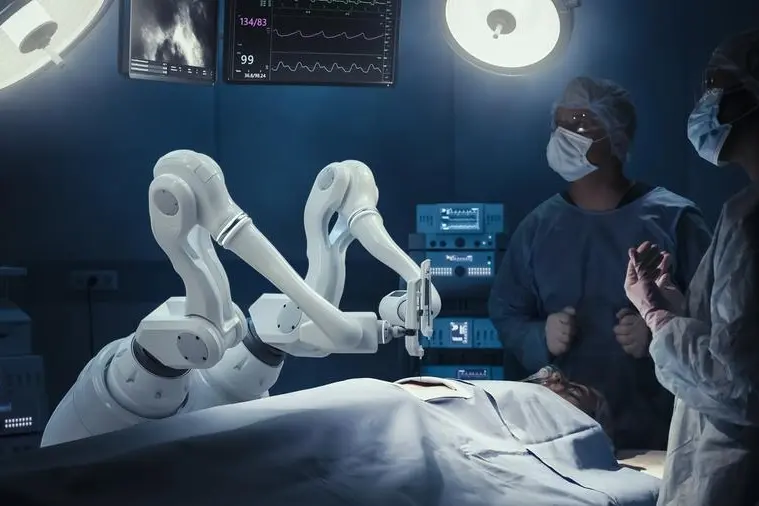




Samsung Electronics has announced an ambitious strategy to convert all its domestic and international production plants into AI-driven autonomous factories by 2030. The global tech giant plans to leverage a suite of advanced technologies, including digital twins, AI agents, and humanoid robots, to fundamentally reshape its manufacturing processes, aiming for significant boosts in quality, productivity, and safety.
The announcement, made at MWC26 in Barcelona, signals a major shift from simple automation to full operational autonomy, where AI systems will not only perform tasks but also make optimal decisions independently.
The Vision for an AI-Driven Factory
At the core of Samsung’s plan is the implementation of digital twin-based simulations across the entire production lifecycle, from material receipt to final shipment. These virtual replicas of physical factories will allow the company to conduct data-driven analysis and pre-verification of processes, using specialized AI agents for quality, production, and logistics to optimize operations before they occur in the real world.
This move is designed to create a hyper-efficient manufacturing ecosystem where potential issues are identified and resolved proactively, minimizing downtime and maximizing output.
Leveraging Agentic AI from Mobile to Manufacturing
Samsung intends to transfer its deep expertise in AI from its consumer mobile division directly to the factory floor. The company will apply the “agentic AI” technology, reportedly introduced with the Galaxy S26, to its manufacturing innovation. Agentic AI refers to systems that can autonomously understand goals, create plans, and execute complex tasks to achieve them.
By deploying AI agents to intelligently manage production, equipment, repairs, and logistics, Samsung aims to build a strong foundation for on-site autonomy, allowing its manufacturing systems to operate with unprecedented independence and intelligence.
Humanoid Robots and Safety Bots on the Factory Floor
To complete the transition to full autonomy, Samsung will gradually introduce humanoid manufacturing robots across all its processes. These robots will work alongside other specialized bots, such as those managing production lines and logistics, to create highly optimized and flexible manufacturing sites.
Furthermore, the company is prioritizing worker safety by developing digital twin-based environmental safety bots. These bots will be deployed in challenging conditions with high temperatures or noise levels to detect and mitigate risks, systematically enhancing safety standards across its global facilities.
Lee Young-soo, Vice President and Head of Samsung’s Production Technology Research Center, stated, “The future of manufacturing innovation lies beyond simple automation, with the key being the establishment of autonomous manufacturing sites where AI understands the field and executes optimal decisions independently. We will reinvent ourselves as the center of global manufacturing innovation combined with AI.”
Implications for MENA’s Manufacturing and Tech Sectors
Samsung’s forward-looking strategy offers a glimpse into the future of industrial manufacturing, a development of keen interest to the MENA region. As nations like Saudi Arabia and the UAE aggressively pursue economic diversification through initiatives like Vision 2030 and Operation 300bn, building advanced manufacturing capabilities is a top priority. Samsung’s blueprint provides a potential roadmap for how AI, robotics, and IoT can be integrated to create world-class industrial hubs.
For the region’s tech ecosystem, this trend signals a rising demand for talent skilled in industrial AI, robotics, and data science. It also presents significant opportunities for MENA startups specializing in enterprise AI solutions, industrial IoT (IIoT), and digital twin technology to partner with or provide services to large-scale manufacturing projects taking root in the region.
About Samsung Electronics
Samsung Electronics is a South Korean multinational corporation and a global leader in technology, headquartered in Suwon. The company is a major manufacturer of electronic components such as lithium-ion batteries, semiconductors, image sensors, and camera modules, as well as consumer electronics including mobile phones, televisions, and home appliances.
Source: Tech In Asia