



Dubai and Abu Dhabi have cemented their positions as leading global smart cities, securing top spots in the latest Smart City Index 2026 published by the Swiss business school [IMD]. Ranking sixth and tenth globally, respectively, the two UAE hubs lead all other Arab cities, demonstrating the success of the country’s long-term digital investment strategy. While the UAE took the top spots, Saudi Arabia showcased its growing urban ambitions, with six of its cities placing in the MENA top ten.
Quick Facts
- Dubai ranks 6th, Abu Dhabi 10th globally.
- Saudi Arabia features six cities in MENA’s top ten.
- Public trust is more vital than tech investment alone.
UAE Sets the Regional Benchmark
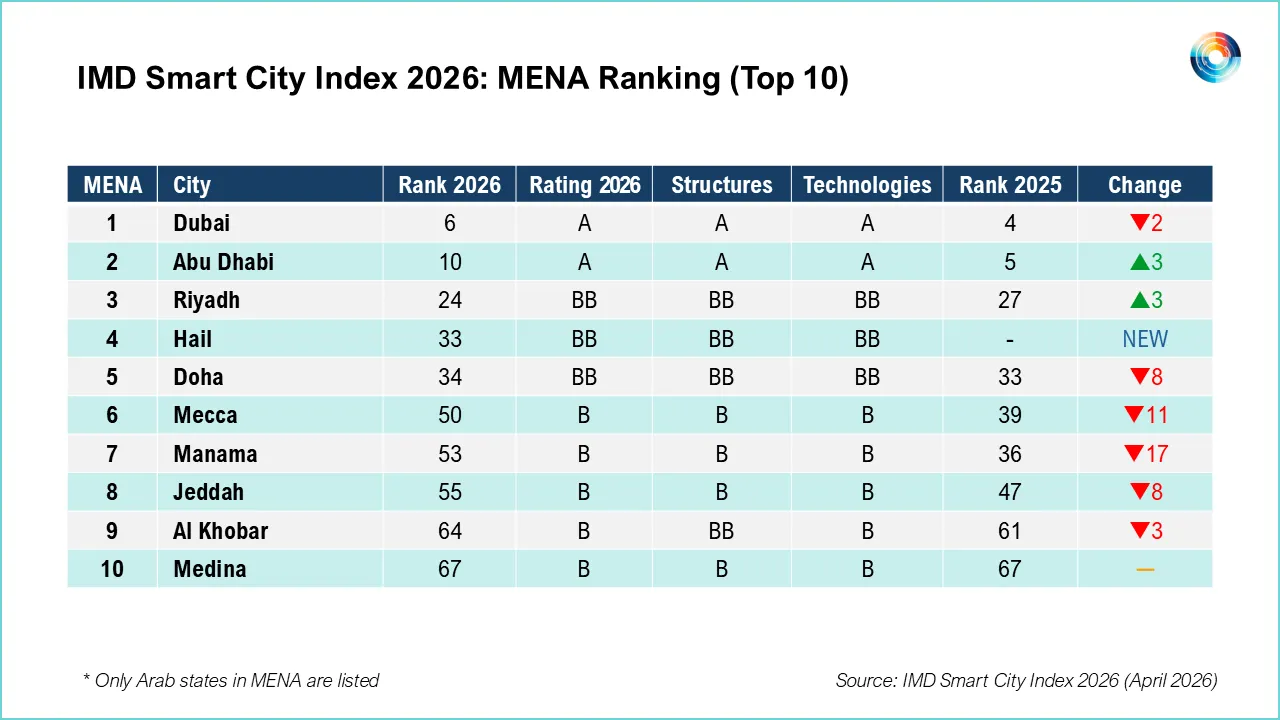
The UAE is the only country in the MENA region to have two cities in the global top ten. Dubai achieved a sixth-place ranking with a top ‘A’ rating across both the Structures and Technology pillars—the highest score awarded. Abu Dhabi followed closely in tenth place, also earning an ‘A’ rating on both pillars.
The report highlights that the Gulf’s model of state-directed digital investment, when combined with high-quality service delivery, directly translates into citizen confidence. Both UAE cities scored above 0.76 on the technology pillar, with public trust in online government services reaching 95.7% in Dubai and 89% in Abu Dhabi.
Saudi Arabia Shows Scale and Ambition
While the UAE claimed the highest rankings, Saudi Arabia demonstrated significant breadth and progress. Six Saudi cities were featured in the Arab top ten, the most of any country. Riyadh climbed three places to 24th globally, reinforcing its status as a major regional hub.
The Kingdom also saw impressive results from its developing cities. Hail made its debut on the index at 33rd, the highest first-time entry in the region, while AlUla recorded the biggest regional climb, jumping 27 places from 112th to 85th. This surge reflects the rapid development and infrastructure investment transforming the city under Saudi Vision 2030.
A Widening Gulf Divide
Performance among other Gulf cities was mixed. Doha ranked fifth in the Arab region but dropped to 34th globally from 26th last year. Manama saw the sharpest decline among Gulf cities, slipping 17 places to 53rd.
Outside the Gulf, the gap in smart city development is becoming more pronounced. Cities like Rabat (124th), Cairo (125th), Amman (130th), and Beirut (145th) ranked low and mostly slipped from their 2025 positions, pointing to a growing disparity between Gulf and non-Gulf Arab urban centers.
The Gulf’s Super-App Strategy Pays Off
The index results reflect years of focused investment in digital public services across the GCC. The UAE has built a sophisticated digital government ecosystem around UAE PASS, its national digital identity platform. This is complemented by super-apps like Abu Dhabi’s AI-powered TAMM, which serves 3.6 million users, and DubaiNow, covering services from 44 public entities.
Saudi Arabia’s Tawakkalna super-app now serves 34 million users with over 600 government services. This successful model is now influencing policy beyond the region, with Morocco launching its own Idarati X.0 super-app project in February 2026, explicitly built on similar design principles.
About the IMD Smart City Index
The IMD Smart City Index assesses 148 cities globally across five pillars: health and safety, mobility, urban activities, opportunities, and governance. The index combines quantitative data with resident perception surveys to measure how inhabitants experience urban technology and infrastructure. Its central finding this year is that institutional structures are a stronger predictor of smart city performance than technology scores alone.
Source: Middle East AI News