




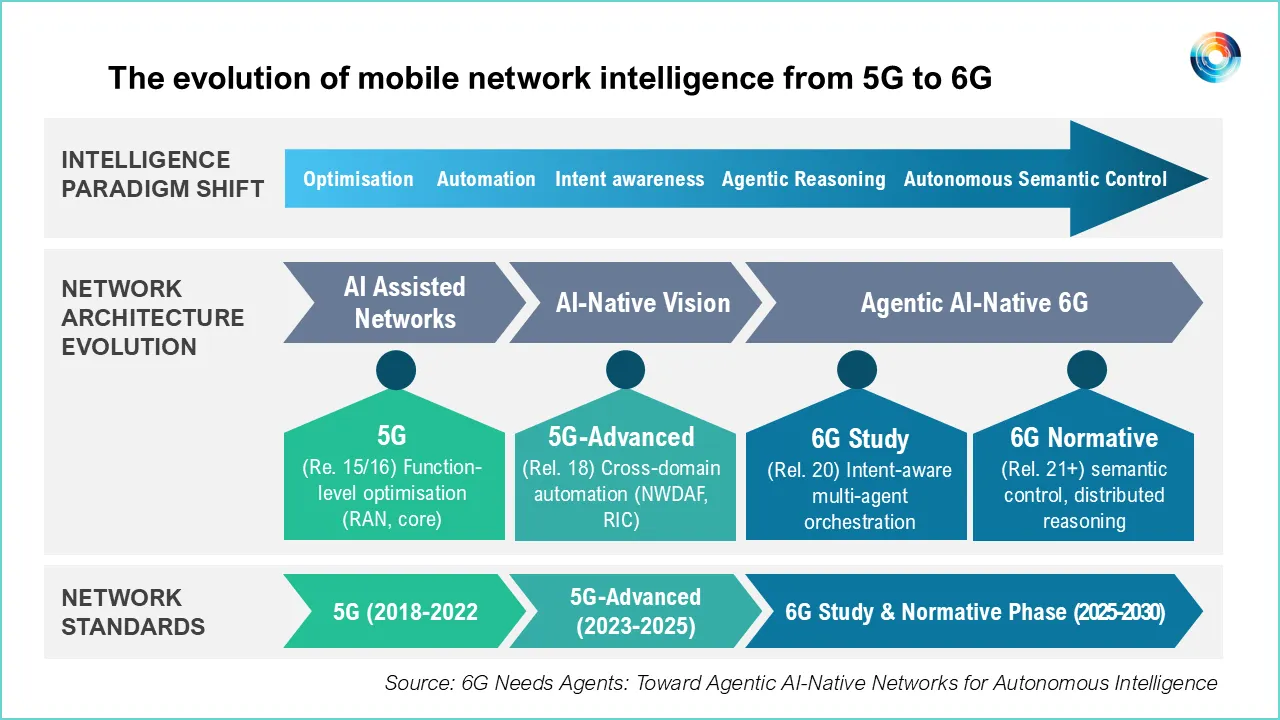
Researchers from two of the UAE’s top institutions, UAE University and Abu Dhabi’s Khalifa University, have published a paper arguing that the next generation of mobile networks must be built with fully autonomous, reasoning AI agents at their core. The paper warns that architectural decisions made in the next two years will define 6G, and the window is closing to shift from today’s narrow, reactive AI to truly intelligent, self-managing networks.
Quick Facts
- Proposing a four-layer agentic AI architecture for 6G.
- Developed
6G-Bench, a benchmark to test LLM performance. - Results show no single AI model meets all 6G needs.
- Research aligns with global 6G standardization efforts.
Moving Beyond Optimization
Most artificial intelligence used in telecom networks today is designed for optimization. It excels at specific, narrow tasks but lacks the ability to reason, interpret intent, or autonomously coordinate complex actions across the entire network.
The new paper, titled 6G Needs Agents: Toward Agentic AI-Native Networks for Autonomous Intelligence, makes the case for embedding agentic AI at the architectural level before global 6G standards are locked in place between now and 2027. This research team includes Mohamed Amine Ferrag and Abderrahmane Lakas from UAE University, and Merouane Debbah from Khalifa University’s Digital Future Institute.
A New Blueprint for an AI-Native 6G
The researchers propose a four-layer agentic architecture designed to sit on top of standard 3GPP telecom infrastructure. The core of this proposal is a dedicated semantic control plane where Large Language Model (LLM)-based agents act as reasoning entities.
These agents would handle intent-aware and context-driven decision-making, working in concert with the underlying network hardware. The architecture spans the entire network, from individual devices to the edge and core, creating a distributed multi-agent system capable of autonomous intelligence.
Putting Theory to the Test with 6G-Bench
To validate their approach, the team built 6G-Bench, the first open benchmark designed to evaluate how well foundation models handle network-level reasoning under realistic 6G constraints. The benchmark tested 27 different AI models against 30 decision-making tasks derived from over 113,000 scenarios.
A key finding was that no single AI model can simultaneously satisfy all 6G performance requirements. High-capability models delivered superior reasoning but came with high latency and memory costs. Conversely, smaller, compressed models ran efficiently but with significantly reduced reasoning accuracy.
The results strongly suggest that a heterogeneous deployment of AI agents is the most practical path forward. This would involve placing different types of LLM agents at various points across the network—device, edge, and core—depending on the specific performance trade-offs required at each layer. The team also found that model compression techniques affect different models unpredictably, highlighting the need for system-level optimization by network operators.
A Critical Window for Standardization
This research from the UAE is directly aligned with ongoing standardization discussions within major global bodies, including 3GPP (Release 20 and 21), the ITU’s IMT-2030 framework, and the ETSI’s zero-touch service management initiatives. All of these groups are exploring pathways toward more intent-driven, AI-native network architectures.
By open-sourcing 6G-Bench, the researchers have provided network operators, equipment makers, and other academic institutions with a crucial, independent tool to assess if today’s AI models are ready for the demanding environment of 6G networks.
About UAE University and Khalifa University
UAE University (UAEU) is the first and foremost comprehensive national university in the United Arab Emirates. Founded in 1976 by the late Sheikh Zayed Bin Sultan Al Nahyan, UAEU is a research-intensive institution driving national development.
Khalifa University is an internationally ranked research university based in Abu Dhabi, UAE. It focuses on advancing science, engineering, and medicine through teaching and research, contributing to the UAE’s knowledge-based economy.
Source: MEAIN