
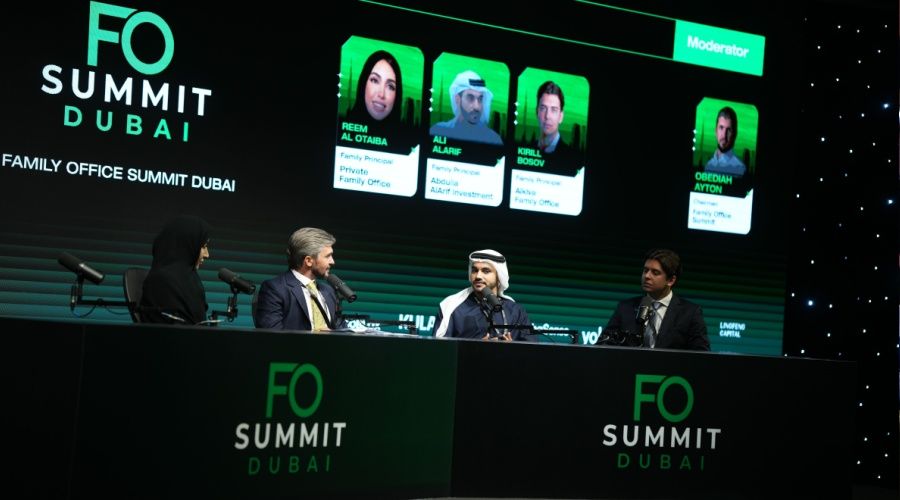
A fundamental shift is underway in how the Gulf’s most influential families manage their wealth, moving from preservation to strategic global positioning. This evolution was the central theme at the recent Family Office Summit Dubai, which gathered 254 participants, including 81 family offices and 103 family holdings, representing an ecosystem managing over $1.2 trillion in assets.
Discussions at the summit moved beyond theory to focus on execution, highlighting a clear message: long-term wealth creation now demands institutional-grade structure, operational speed, and a global outlook.
Dubai Cements Itself as a Global Wealth Hub
The summit underscored Dubai’s transformation from a regional financial center into a global nexus for private capital. Delegates attended from across the Middle East, Europe, Asia, and North America, drawn to an ecosystem that now oversees more than $1.2 trillion in assets through local family offices and related entities.
Obediah Ayton, Chairman of the Family Office Summit, noted the discussions reflected a “disciplined, forward-looking approach to wealth management,” as families adapt their capital allocation and governance for a rapidly changing landscape.
Governance First Institutionalises Family Capital
A foundational theme throughout the event was the critical importance of governance. Experts emphasized the need to create a clear separation between operating businesses and family wealth through formal holding structures, trusts, and well-defined investment frameworks.
This move aims to reduce emotional decision-making and preserve alignment across generations, reflecting a broader institutionalization of family capital in the region. Gulf-based families are increasingly adopting the rigorous frameworks of sovereign funds and institutional investors, anchoring their strategies in strong governance.
Private Markets Dominate Investment Strategy
With governance as the bedrock, conversations quickly turned to capital deployment, where private markets took center stage. Family offices in the UAE are deepening their exposure through co-investments, direct deals, secondaries, and private credit.
This trend is backed by significant capital flow. During the first half of 2025, UAE family offices were the driving force behind nearly $3 billion in venture capital deals. This capital is not passive; it is active, directional, and increasingly global in its reach. Dubai’s financial infrastructure continues to support this growth, with the emirate recording a nearly 40% increase in new asset and wealth management registrations in 2025.
A Strategic Pivot Towards Asia
The summit highlighted a deliberate geographic diversification toward Asia, with Hong Kong positioned as a strategic gateway for technology-driven investments into mainland China. Participants pointed to opportunities in sectors where capital and industrial policy are converging, including artificial intelligence, semiconductors, quantum computing, and humanoid robotics.
This capital flow is becoming reciprocal, with Chinese firms increasing their investment presence in the UAE, particularly in AI and advanced computing. For MENA family offices, Asia is no longer an experiment but a calculated portfolio shift away from traditional Western markets.
AI as a Tool for Sharper Judgement
Artificial intelligence was treated not as a buzzword but as essential infrastructure. Family offices are deploying AI as a productivity enhancer to strengthen due diligence, improve reporting, boost operational efficiency, and tighten governance.
The consensus was clear: AI will not replace human judgment but will sharpen it. While human oversight remains paramount in a structure built on trust, families are integrating AI as an operational layer to manage scale and complexity with greater analytical precision.
About Family Office Summit Dubai
The Family Office Summit Dubai is a premier gathering for family offices, high-net-worth individuals, and their advisors from the MENA region and across the globe. The event focuses on substantive discussions around wealth management, capital allocation, governance, and investment trends, facilitating dialogue and collaboration within the private capital ecosystem.
Source: Wamda