



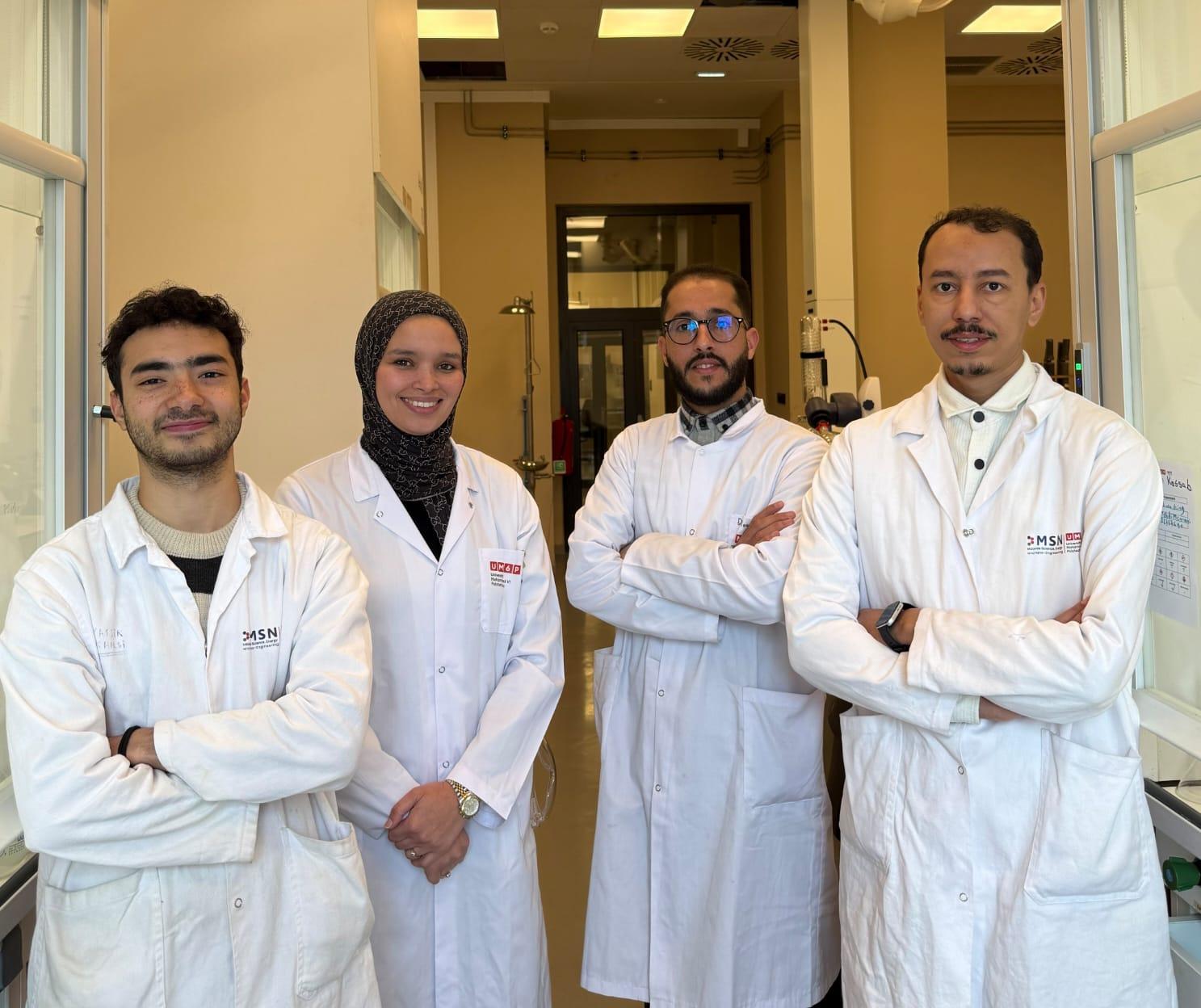
Researchers at Morocco’s University Mohammed VI Polytechnic (UM6P) are developing a process to convert millions of tons of local agricultural and industrial plant waste into high-value, graphene-like materials. The initiative uses laser technology to transform carbon-rich waste, like olive pomace and sugar industry byproducts, into advanced materials for the energy and electronics sectors.
Quick Facts
- Converts plant waste into graphene-like carbon material.
- Uses a fast, chemical-free laser graphitization process.
- Aims to create electrodes, sensors, and purification materials.
From Plant Waste to Graphene in Seconds
The team, part of UM6P’s College of Chemical Science & Engineering, is focusing on lignin, a natural polymer abundant in plant biomass. Instead of traditional methods that require long furnace cycles and harsh chemicals, the researchers use a technique called laser-induced graphitization.
A focused laser beam rapidly heats the surface of the lignin-based material, reorganizing its carbon atoms into a porous and conductive structure similar to graphene. The entire conversion happens in seconds.
“When the laser scans the surface of lignin-based material or biomass in general, it generates a very high localized temperature,” said Mehdi Mennani, a researcher on the project. “This heat reorganizes the carbon atoms in lignin into porous and conductive carbon material.”
He added that the speed is a significant advantage. “We can call it ultrafast processing, unlike the classical method of putting the material in an oven or furnace at high temperature.”
The team is actively testing local feedstocks, including bagasse from the sugar industry, olive pomace, and alfa fibers, and is working with Moroccan companies like sugar operator Cosumar to study real-world waste streams.
Unlocking Commercial Applications in Energy and Sensors
The resulting material’s porous structure and high electrical conductivity make it ideal for immediate, practical uses.
“The material produced has a highly porous structure and excellent electric conductivity, which makes it very suitable for electrodes in supercapacitors or batteries,” Mennani noted.
Beyond energy storage, the technology can be used to pattern graphene directly onto surfaces, creating flexible sensors for agriculture, smart packaging, or wearable devices. It also has potential applications in environmental tech for pollutant detection and water purification.
Tackling Industrial Scale-Up and Material Consistency
While promising, the path to industrial adoption has significant hurdles. One of the main challenges is the variability of the raw material. Lignin’s structure can differ depending on its plant source, which affects the final quality of the laser-treated material.
“Lignin from different biomass sources can have different molecular structure impurities or mineral content. Even these variations can affect or influence how the material decomposes during laser treatments,” Mennani explained.
Scaling the process from small lab samples to continuous industrial production while maintaining consistent quality is another major challenge the team is addressing.
An AI-Powered Vision for Morocco’s Biomass Industry
To overcome these obstacles, the UM6P team is combining physical experiments with theoretical modeling and machine learning. By using AI, they aim to predict the optimal laser settings for different types of biomass, significantly reducing the time and cost of experimentation.
“If you want to do 100 experiments, machine learning can help reduce that to 5 or 10 experiments using the laser,” Mennani said.
The long-term vision is to create a domestic supply chain that converts Morocco’s agricultural byproducts into critical components for its energy and tech industries.
“We want to build a Moroccan AI platform linking biomass with experiments. And instead of doing a lot of experiments, we may reduce that time, energy, and cost… This is our vision,” Mennani concluded.
About University Mohammed VI Polytechnic (UM6P)
University Mohammed VI Polytechnic is a Moroccan non-profit research university. Located in Benguerir, near Marrakech, UM6P is focused on applied research and innovation relevant to Morocco and the broader African continent, with a strong emphasis on science, technology, and sustainable development.
Source: Morocco World News