


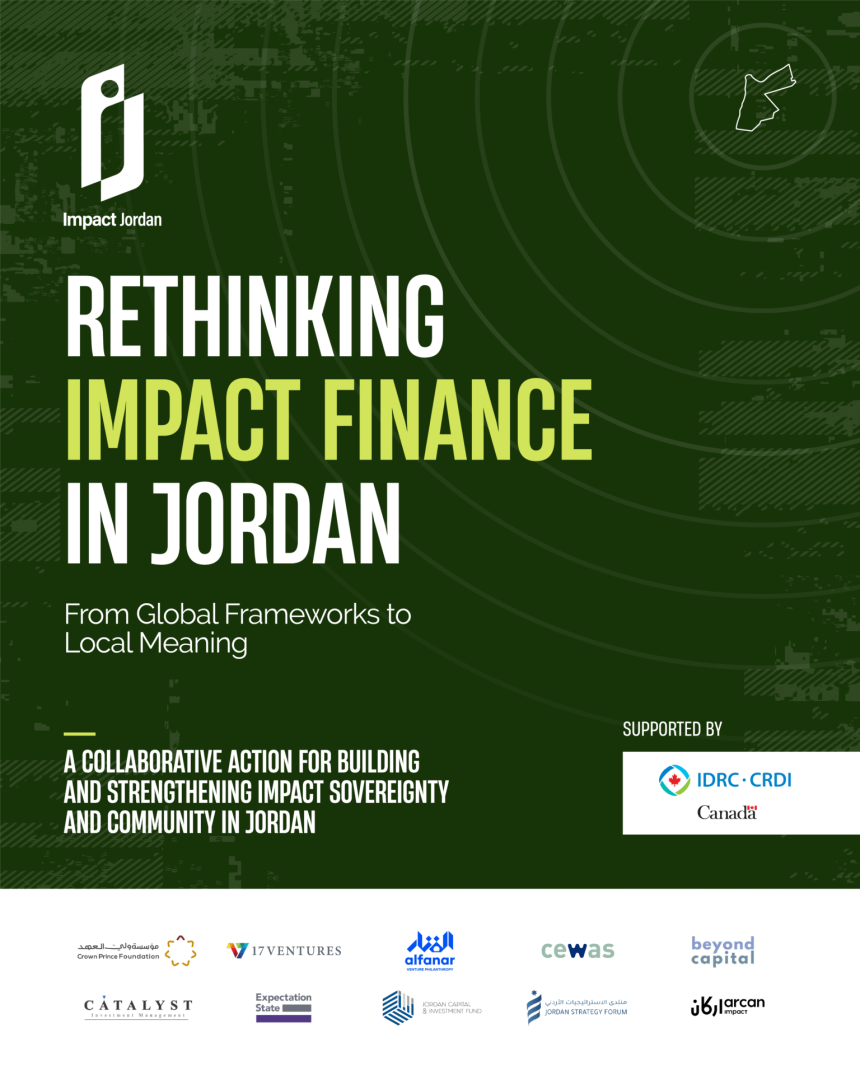
The landmark report “Impact Jordan: Finance, Ethics, and the Return of Meaning” explores the critical evolution of Jordan’s impact finance sector. Funded by the International Development Research Centre (IDRC) and authored by founding members of Impact Jordan, the research argues that for the ecosystem to achieve long-term legitimacy, it must move beyond merely “contextualising” global frameworks to “localising” impact based on indigenous ethical systems.
Contextualisation vs. Localisation: A Power Shift
The research identifies a profound distinction between how global models currently interact with Jordan and how they must evolve to be sustainable:
- Contextualisation (The Current Phase): This involves technical adjustments to global tools like the SDGs, ESG, or IRIS+ to make them more “acceptable” in local settings. In this phase, accountability remains externally anchored toward international donors and development finance institutions (DFIs).
- Localisation (The Proposed Future): This is a deeper reorientation that centers local ethics and indigenous knowledge. It demands “epistemic sovereignty,” where the Jordanian community defines success based on its own moral and historical frameworks.
- Readiness Level: Despite high activity, the report notes that Jordan is closer to “dawn” than “noon” in its true localisation journey.
Indigenous Ethical Anchors
The report identifies three primary indigenous systems that offer deep-rooted legitimacy for a localized impact ecosystem:
- Islamic Finance: Jordan’s most developed indigenous system, rooted in maqāşid al-sharī a (the objectives of Sharia). While robust in legal compliance, the report calls for an evolution toward “Islamic Finance 2.0,” which moves beyond mimicking Western models to address 21st-century crises like climate risk and technological inequality.
- Tribal Social Structures: These systems emphasize kinship, reciprocity, and trust-based informal economies. Though resilient, they remain largely undocumented and unintegrated into formal impact measurement tools.
- Relational Wellbeing: Local values such as social dignity (karāma), family security, and communal generosity provide a broader definition of “value” than standard economic metrics like income or job growth.
The Role of Impact Jordan
Impact Jordan is a collaborative movement comprised of the Kingdom’s leading impact organizations, including 17 Ventures, Beyond Capital, Expectation State, and the Jordan Strategy Forum.
- Platform for Change: The group acts as a catalyst for localisation by investing in shared metrics design and participatory narrative development.
- Strategic Autonomy: Notably, Impact Jordan made a deliberate decision not to seek accreditation with the Global Steering Group for Impact Investment (GSG Impact) to avoid being tethered to a top-down, global north logic that did not fully resonate with local values.
- Institutional Support: The initiative is currently incubated within the Crown Prince Foundation (CPF), providing it with vital local legitimacy and operational capacity.
Strategic Implications and Future Directions
The report concludes with a roadmap for transforming Jordan into a regional leader in values-driven finance:
| Stakeholder | Key Recommendations |
| Policymakers | Establish regulatory space and incentives for ethics-first financial innovation. |
| Universities | Take a lead role in theorising indigenous ethics and designing pluralistic curricula. |
| Practitioners | Move beyond performance optimization toward co-designing metrics with local communities. |
| Regional Actors | Co-create an Arab ethical finance compact to facilitate South-South collaboration. |
Jordan has a unique opportunity to lead the region not by perfecting existing models, but by co-authoring new ones grounded in its own moral and historical terrain.
About Impact Jordan
Impact Jordan is a collaborative movement committed to building and strengthening the impact ecosystem in Jordan and the wider Arab Region. Incubated within the Crown Prince Foundation, it brings together a diverse range of actors—from investors and academics to community organizations—to co-create a locally grounded approach to impact.
Source: Impact Jordan