


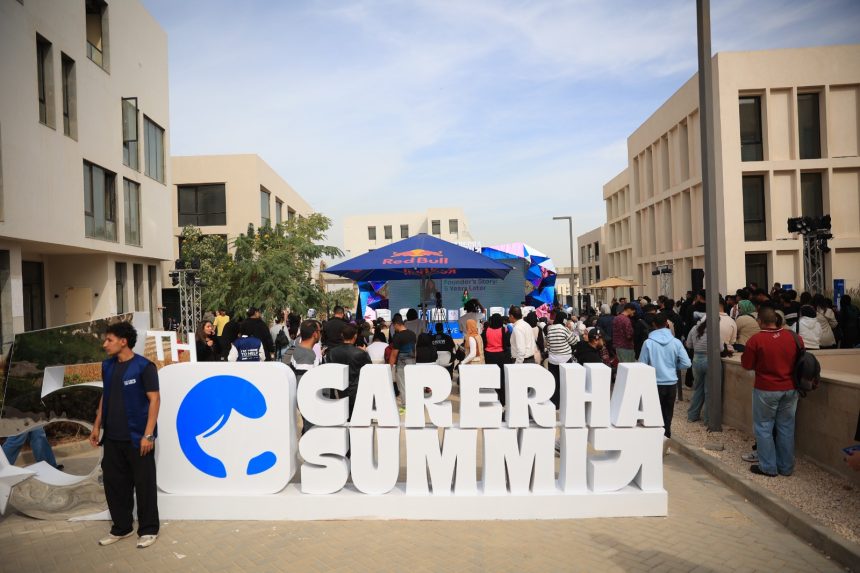
At the Careerha Summit in O West, 6th of October City, founders and finance executives discussed how technology can widen access to financial services and what it takes to turn a startup idea into a sustainable business. Two sessions focused on financial innovation, testing ideas with customers and knowing when to change direction or stop.
In a discussion on the future of money and finance, valU founder and CEO Walid Hassouna, Money Fellows founder and CEO Ahmed Wadi, and Sympl co-founder and chief commercial officer Yasmin Hena spoke with economist and financial adviser Omar El Shenety.
Hena said Sympl was created to address a gap in Egypt, where many people have debit cards but limited access to credit or financing, partly because of lengthy banking procedures or reluctance to deal with banks. The company offers short-term financing through partner merchants, allowing customers to split purchases using debit or credit cards without opening an account or registering on an app. The service targets everyday spending, including medical care, fashion and sports subscriptions, with limits of up to EGP 30,000, she said.
Hassouna said valU spent about two years working before it saw a meaningful response from the market. The experience led the company to simplify registration and account activation, he said, adding that startups should launch and test products rather than wait for a perfect version, then improve them using customer feedback.
He also discussed the responsibilities that come with being listed on the stock exchange, including ongoing disclosure and managing the expectations of a broad shareholder base. ValU’s shareholders and partners include private equity investors, institutions and major companies such as Amazon, Hassouna said. He described consistent financial performance and a focus on the company’s strengths as important in managing those relationships.
Wadi said Money Fellows grew from his difficulty finding a suitable financial service. The company digitized the traditional savings-circle model, adding contracts and safeguards to help people join circles beyond their existing personal networks. It has since developed its platform from digital participant registration into a network designed to match members, he said.
Money Fellows launches more than 100,000 savings circles a month, according to Wadi. Matching people who want to borrow with those looking to save is an ongoing challenge, he said, describing recommendation technology and credit assessments as important tools. He added that the model does not rely on operating capital or debt.
A second session, on lessons from building companies that founders rarely discuss, featured Exits MENA founder Mohamed Abou El Naga, Bosta founder and CEO Mohamed Ezzat, and Simplex CNC CEO Ahmed Shaaban. Careerha founder and CEO Jessie Radwan moderated the conversation.
Abou El Naga and Ezzat both stressed that an idea is only a starting point: founders need to test whether customers want the product and are willing to pay for it. Early sales do not necessarily prove that a business model can scale, Ezzat said. If demand is weak, founders may need to change the product or model, or stop the project.
Both speakers warned that attachment to an original idea, money already spent and an unwillingness to acknowledge mistakes can keep founders pursuing an unworkable business. Abou El Naga also said the funding environment was more limited when he started out than it is today, when founders have more room to experiment.
Shaaban said Simplex CNC began after co-founder Amr Osman encouraged him to turn a graduation project into a company. Their complementary technical and commercial experience, built over five years at university, helped them launch the business. Unlike startups centered on apps, Simplex CNC works with machinery and industrial processes, making it harder to walk away given the limited initial investment, Shaaban said. In the early days, the priority was delivering machines to customers who had paid for them. He said responsibility to customers and investors, rather than the pursuit of a major achievement, kept the team going.
Source: العالم اليوم