





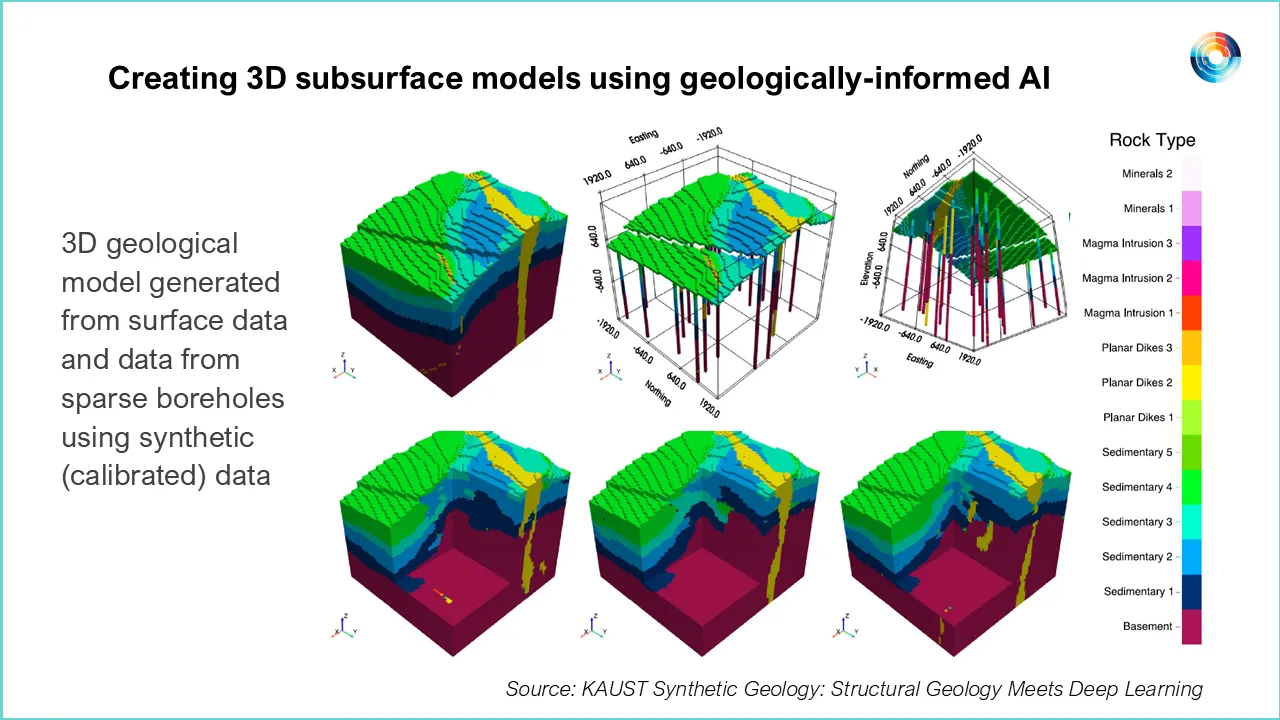
Thuwal-based King Abdullah University of Science and Technology (KAUST) has developed a generative AI model designed to reduce uncertainty in mineral exploration.
The geological foundation model generates multiple plausible 3D views of underground rock formations using surface observations and limited borehole data. Each scenario includes a quantified level of uncertainty, giving geologists several hypotheses to assess rather than one fixed interpretation.
Researchers trained the 78-million-parameter model on several hundred thousand synthetic geological models using KAUST’s Shaheen III supercomputer. The training data was produced with StructuralGeo, a simulator that reproduces tectonic, magmatic and sedimentary processes over millions of years.
Saudi national mining company Ma’aden has signed a 30-month research and development contract to test the prototype with real Saudi geological data, according to the announcement.
The project is led by KAUST professors George Turkiyyah and David E. Keyes, with researchers from the University of British Columbia and KAUST. The team said the tool is intended to support, rather than replace, geological expertise by helping professionals compare multiple underground scenarios when data is limited.
Source: Middle East AI News