


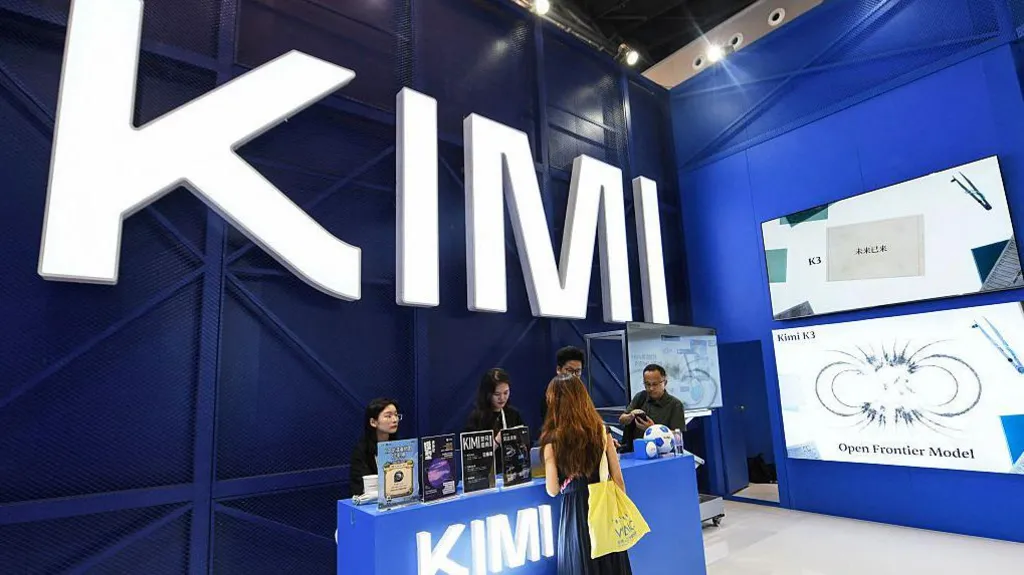
In a move signaling a significant escalation in the global AI race, Beijing-based Moonshot AI has introduced Kimi K3, a massive open-weight model with 2.8 trillion parameters. The release challenges the long-held assumption of Silicon Valley’s clear lead at the AI frontier and presents a powerful new tool that could reshape enterprise AI strategies, including in the MENA region.
Quick Facts
- World’s largest open-weight AI model
- 2.8 trillion parameter scale
- Requires 1.4TB of memory for deployment
A New Heavyweight in the AI Arena
Kimi K3’s scale is a major leap, surpassing other large-scale Chinese models and setting a new benchmark for open-weight systems. While parameter count isn’t the only measure of performance, it indicates a model’s complexity and potential capabilities. Moonshot AI claims its internal testing places Kimi K3 ahead of most US systems, trailing only OpenAI’s GPT-5.6 Sol and Anthropic’s Claude Fable 5, particularly showing strong results in coding benchmarks.
The move contrasts sharply with the proprietary, closed-door approach of leading US labs. By making the model’s weights publicly available for download and modification, Moonshot AI and other Chinese firms are creating a distinct path centered on open access, even as Washington tightens export controls on advanced AI technology.
Trading Compute for Memory
Instead of relying on sheer computational force, Kimi K3 employs a Mixture of Experts (MoE) architecture. The model is segmented into 896 specialized “experts,” activating only 16 for any given task. This design drastically cuts down the computational power needed during inference.
However, this efficiency comes with a trade-off: the entire model must be loaded into memory. To manage this, Moonshot trained Kimi K3 using four-bit precision, compressing the model’s size from a theoretical 5.6TB to a more manageable, yet still enormous, 1.4TB.
The Hardware Hurdle
The model’s substantial memory requirements present a significant barrier to entry. Deploying Kimi K3 locally is impractical for most businesses, as it demands far more memory than a standard enterprise server can offer. Moonshot recommends a setup of 64 or more interconnected AI accelerators operating as a single memory pool.
This makes deployment a question of infrastructure, favoring large corporations or cloud providers. Furthermore, software support is still catching up. Because of its novel architecture, many open-source inference tools are not yet fully compatible, and Moonshot is working with partners to bridge this gap before a wider rollout.
What Kimi K3 Means for MENA’s AI Ambitions
While originating from China, the launch of Kimi K3 has direct implications for the rapidly advancing AI ecosystems in the UAE, Saudi Arabia, and across MENA.
For a region investing billions in AI infrastructure and data sovereignty, a powerful open-weight model presents a compelling alternative to proprietary US systems. Sovereign wealth funds and state-backed tech champions with the capital to build large-scale AI infrastructure are uniquely positioned to leverage Kimi K3. It offers them the ability to fine-tune a frontier-level model on local datasets—particularly for Arabic—while maintaining full control over data within their own jurisdictions. The model’s demanding hardware needs also align with the region’s focus on becoming a global hub for AI computing power.
About Moonshot AI
Moonshot AI is a Beijing-based artificial intelligence company focused on developing large-scale language models. The company aims to build advanced AI systems and is a prominent player in China’s rapidly growing AI sector.
Source: EntArabi