



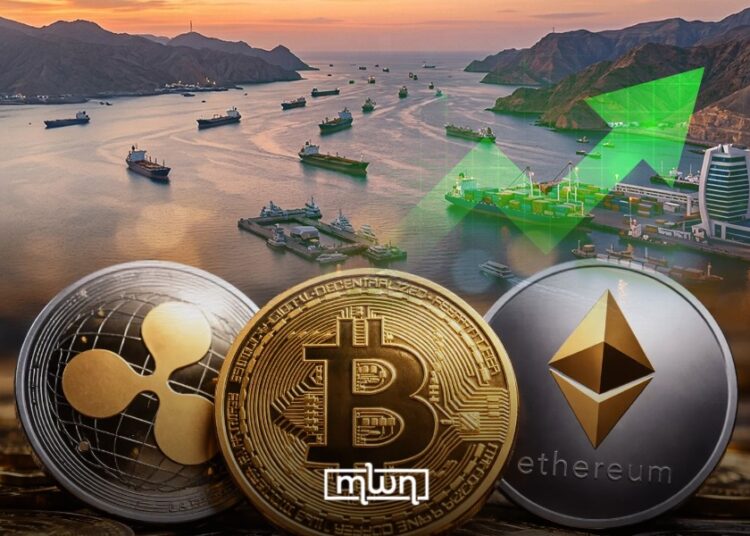
Iran is reportedly demanding cryptocurrency payments from oil tankers for passage through the Strait of Hormuz, a move that highlights crypto’s growing role as a financial tool in geopolitically sensitive regions. The strategy appears designed to circumvent international sanctions, providing Iran with a direct and difficult-to-seize revenue stream while rattling global shipping and energy markets.
Quick Facts
- Reported fee up to $2 million per vessel.
- Payment options include Bitcoin, Tether, and Yuan.
- Iran accounts for 4.5% of global Bitcoin mining.
A Sanctions Workaround
As Iran remains cut off from large parts of the global financial system, cryptocurrencies offer a viable alternative. Reports suggest Iranian authorities have established a system where ships must pay in Bitcoin almost instantly upon receiving instructions. According to data from TRM Labs, Iran’s Islamic Revolutionary Guard Corps (IRGC) may have been accepting these payments since March, with fees reaching as high as $2 million per tanker.
This isn’t Iran’s first foray into digital assets. The country has long used its energy resources to power a significant Bitcoin mining industry, estimated to represent about 4.5% of the world’s total mining activity, to generate revenue for imports.
The Traceability Paradox
While crypto offers a way around traditional banking rails, it is far from anonymous. Bitcoin transactions are recorded on a public, immutable blockchain, making them traceable in real-time. This public ledger creates significant risks for shipping firms attempting to comply with the payment demands, as they could be easily identified by regulators.
Authorities can cross-reference blockchain data with a vessel’s cargo manifests and transit times through the strait to deduce if a crypto payment was made. The risks for facilitators are also high; earlier this year, two UK-registered exchanges, Zedcex and Zedxion, were hit with sanctions for processing crypto transactions linked to the IRGC.
Challenging the Petrodollar
The inclusion of the Chinese yuan alongside Bitcoin and Tether signals a broader strategic ambition: to chip away at the US dollar’s dominance in the global oil trade. Mallika Sachdeva, a strategist at Deutsche Bank, noted that this development could be an early sign of a shift toward a “petroyuan” system, where oil is priced and traded in China’s currency.
This trend is fueled by the increasing use of non-dollar payments in sanctioned trade routes, particularly between Iran and China. As geopolitical pressures mount, the long-standing petrodollar system is facing one of its most significant tests.
About The Strait of Hormuz
The Strait of Hormuz is a critical maritime chokepoint connecting the Persian Gulf with the Gulf of Oman and the open ocean. It is one of the world’s most strategically important waterways, with a significant portion of the world’s liquefied natural gas and a large percentage of total global oil consumption passing through it, making it a focal point of international trade and geopolitical tension.
Source: Morocco World News