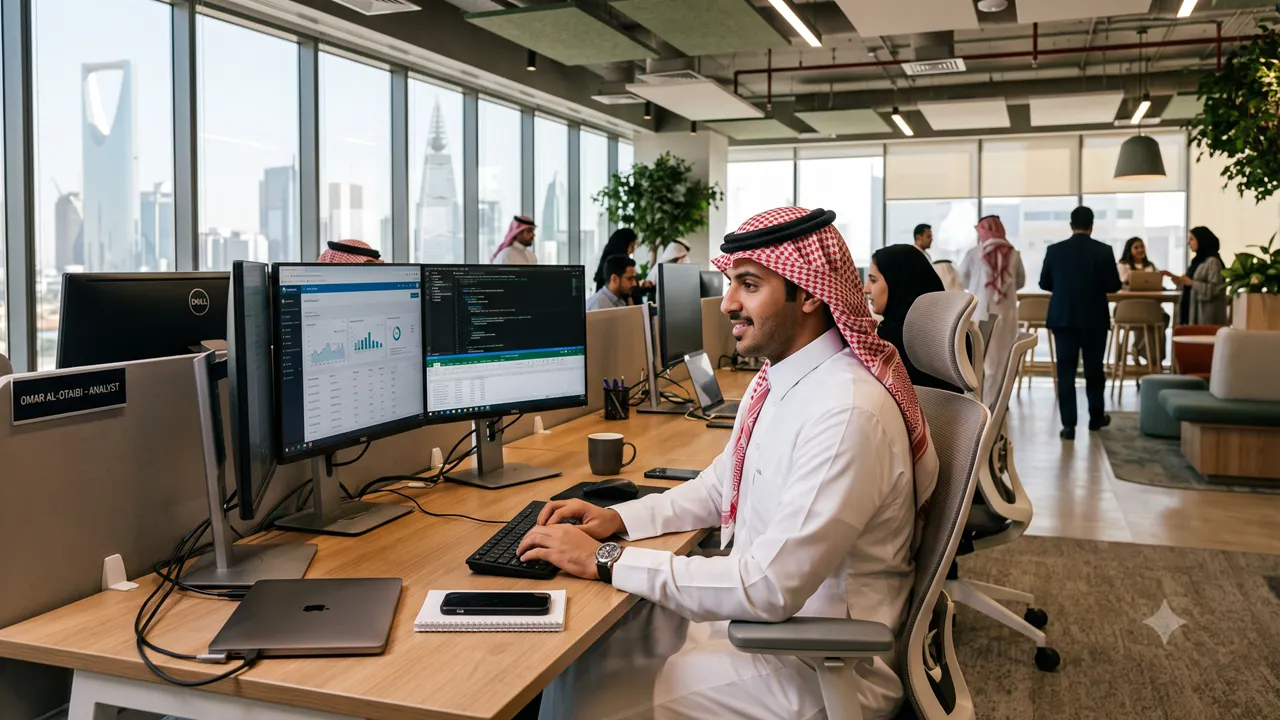




As Saudi Arabia accelerates its Vision 2030 agenda, artificial intelligence is emerging as a core driver of national productivity, competitiveness, and workforce transformation. With new data highlighting rapid AI adoption, the Kingdom is positioning itself to lead the global shift toward digital labor and an innovation-driven economy.
Recent insights from Slack’s Workforce Index reveal that daily AI usage among desk workers has surged by an incredible 233 percent in just six months, signaling a pivotal shift from experimental use to fundamental integration within modern enterprises.
The Surge in AI Adoption
Employees who utilize AI daily are reporting significantly higher levels of productivity and workplace satisfaction. This trend underscores the Kingdom’s readiness to embrace advanced technologies to enhance its human capital and economic output.
“Saudi Arabia has all the ingredients to lead this shift: a young population, a government willing to modernize at extraordinary speed, and industries preparing for global competition,” said Mohammad Al-Khotani, Senior Vice President and General Manager of Salesforce Middle East.
Beyond productivity gains, AI is fundamentally transforming the structure of work itself. Most users report that AI enables them to perform tasks they previously lacked the skills to complete, with trust in the technology growing alongside its continued use. AI is increasingly being applied not just for automation but also to augment creativity, communication, and strategic decision-making.
The Rise of the Agentic Enterprise
The evolution of AI is now advancing toward what industry leaders describe as the “agentic enterprise,” where autonomous AI agents manage complex workflows with minimal human intervention. This next frontier promises to unlock unprecedented efficiency.
According to the MuleSoft Connectivity Benchmark Report, 93 percent of IT leaders are planning to deploy such agents within the next two years.
“AI agents offer a multiplier effect across sectors that Vision 2030 prioritizes. This same efficiency can shift the economics of different industries,” Al-Khotani added.
The Critical Role of Sovereign AI
As the deployment of AI accelerates, regulation has become a critical frontier. The emphasis is on creating a framework that is both innovative and secure, aligning with national policies and laws.
“When we talk about digital labor in Saudi Arabia, we have to acknowledge that legal and regulatory AI is not optional,” said Mohamad El-Charif, founder of Qadi. “Moving early with governed, sovereign agents, lets Saudi organizations encode their own local laws, internal policies, escalation paths and audit trails into the infrastructure.”
This approach ensures that AI acts as a powerful tool for augmentation rather than a replacement for the human workforce. “AI must be introduced as augmentation, not substitution,” Al-Khotani emphasized. By building an integrated, AI-ready foundation now, the Kingdom can continue to advance its Vision 2030 ambitions into a human-centric reality.
About Vision 2030
Saudi Vision 2030 is a strategic framework to reduce Saudi Arabia’s dependence on oil, diversify its economy, and develop public service sectors such as health, education, infrastructure, recreation, and tourism. A key goal is to position the Kingdom as a global investment powerhouse and a hub connecting three continents.
Source: Fast Company Middle East