


Researchers from Abu Dhabi’s Khalifa University have developed a new artificial intelligence model designed to analyze cancer pathology slides with a methodology that more closely mirrors human experts. The model, which was presented at the premier CVPR 2026 computer vision conference, marks a significant step forward in computational pathology by retaining critical details that other systems often discard.
Quick Facts
- New AI model analyzes slides at four scales.
- Outperformed 24 state-of-the-art models.
- Shows its reasoning for pathologists to verify.
A New Approach: Mimicking the Human Eye
Current cancer diagnosis relies on pathologists manually scanning gigapixel tissue images, shifting between magnifications to examine both cellular detail and overall tissue structure. Most existing AI tools built for this task compress the entire slide into a single data summary, a process that risks losing the fine-grained evidence needed for an accurate diagnosis.
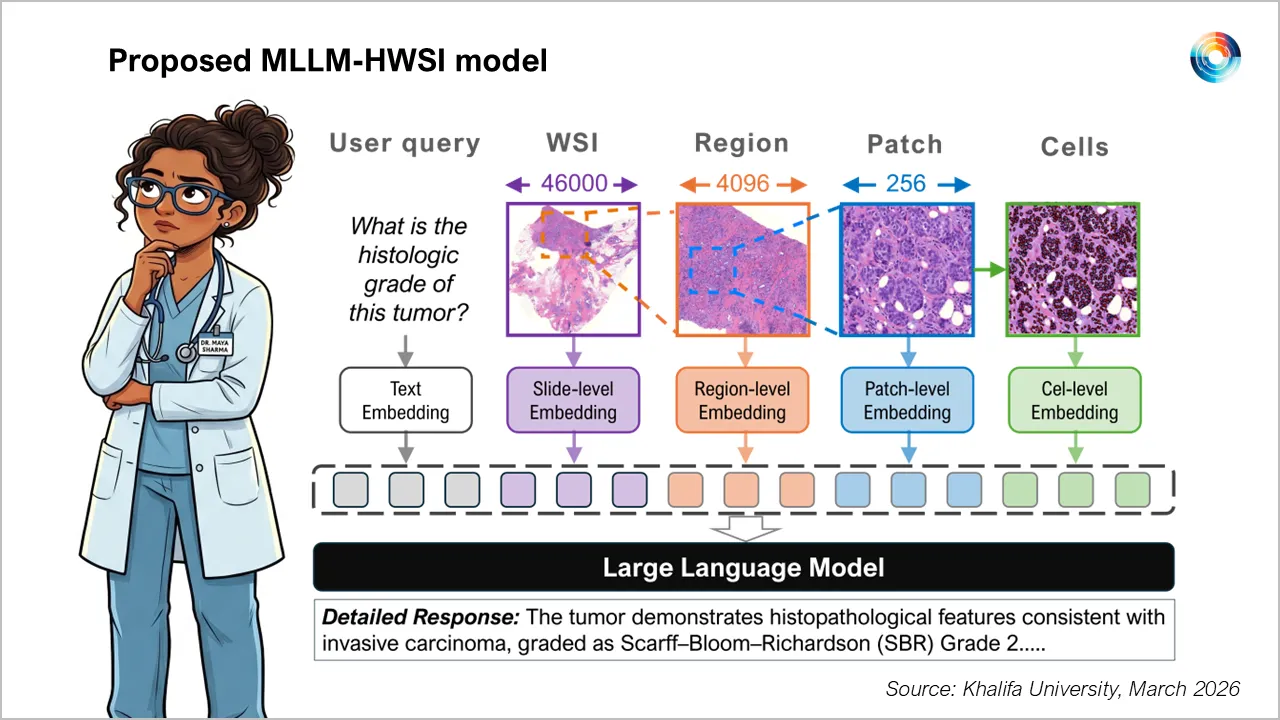
Khalifa University’s model, named MLLM-HWSI, takes a different approach. It analyzes tissue slides across four distinct scales simultaneously, treating individual cells like words, small patches as phrases, and larger regions as sentences, before assessing the entire slide as a complete paragraph. This hierarchical method allows the AI to reason about the image cell-by-cell and region-by-region before reaching a conclusion, much like a human pathologist.
Dominating the Benchmarks
The MLLM-HWSI model was tested against 24 existing state-of-the-art AI systems and consistently outperformed them. The team’s research paper details its superior performance across 13 publicly available whole-slide image benchmark tests, which covered six distinct computational pathology tasks, including classification, retrieval, and report generation.
A key feature of the model is its ability to produce interpretable, evidence-based outputs. It can link specific text-based findings, such as abnormal cell shapes, directly to the exact location on the image that supports its conclusion. This provides a clear and verifiable reasoning trail that a pathologist can follow and trust.
Beyond Pathology: The Vision for a Unified Medical AI
The research team, which includes collaborators from institutions in Pakistan, Saudi Arabia, and Australia, plans to extend the model’s capabilities beyond pathology. The goal is to apply the same hierarchical reasoning to other medical data types, including radiology scans, genomics, and clinical records. This could eventually lead to a unified medical AI system capable of analyzing a patient’s complete medical history to provide comprehensive diagnostic support.
The project team included Sajid Javed, Basit Alawode, Muaz Khalifa Al-Radi, Shahad Albastaki, Moshira Ali Abdalla, and Asim Khan from Khalifa University, alongside collaborators from Information Technology University, Pakistan; King Abdulaziz University, Saudi Arabia; and the University of the Western Australia.
About Khalifa University
Khalifa University of Science and Technology is a public research university located in Abu Dhabi, United Arab Emirates. It is renowned for its focus on science, engineering, and medicine, aiming to support Abu Dhabi’s knowledge-based economy through research and education.
Source: Middle East AI News