



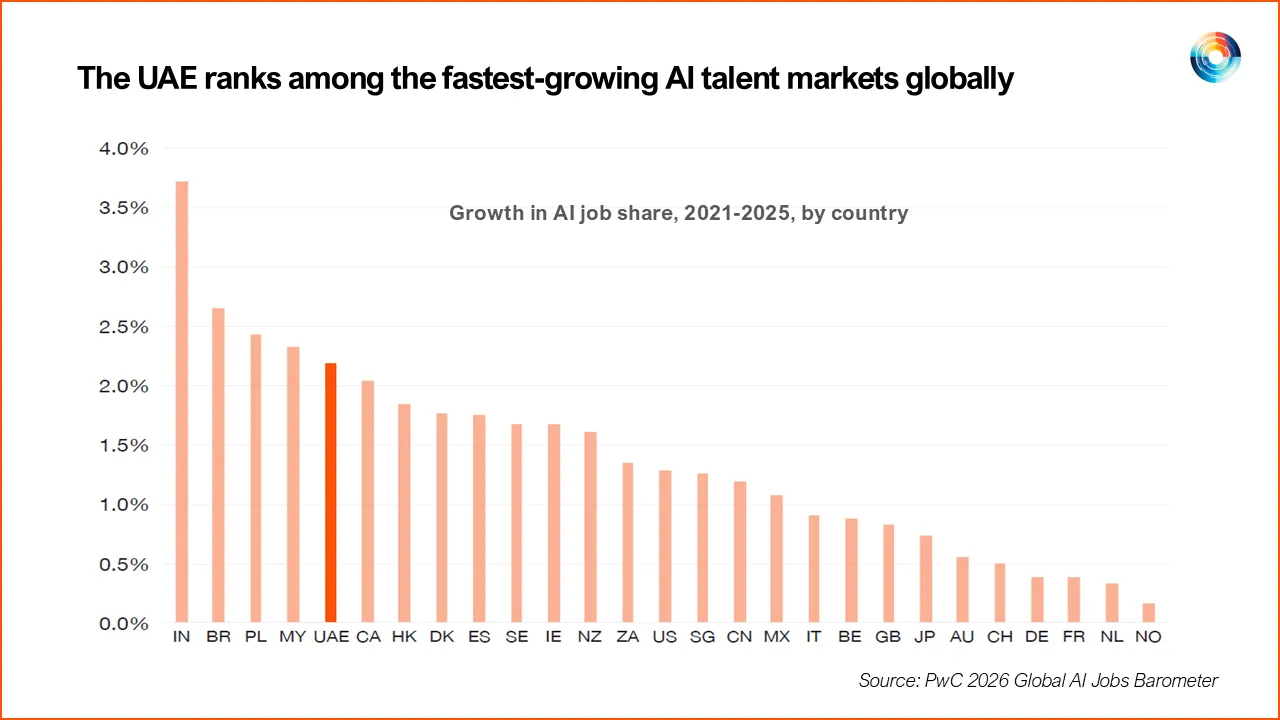
The UAE is solidifying its position as one of the world’s fastest-growing markets for AI talent, according to a new AI Jobs Barometer report from PwC. The study, which analyzed over one billion job advertisements across 27 countries, reveals that roles requiring specialized AI skills are expanding nearly eight times faster than the overall job market, challenging the narrative that AI adoption primarily leads to workforce reduction.
Quick Facts
- AI hiring intensity is rising across all UAE sectors.
- Financial services offers the highest AI wage premium.
- AI-exposed firms show 52% faster headcount growth.
Tech and Finance Lead UAE’s AI Hiring Spree
In the UAE, the push for AI talent is being led by the technology, media, and telecoms (TMT) sectors, which show the highest intensity in AI-related hiring. While TMT is driving the demand, the energy and professional services industries account for the largest overall shares of hiring across the broader labor market.
The report also highlights a significant financial incentive for acquiring AI skills. The financial services sector in the UAE records the highest wage premium for AI capabilities, with sectors more exposed to AI consistently commanding higher salaries than their less-exposed counterparts. This trend aligns with global findings, where the average wage premium for AI skills has climbed to 62%.
The Great Divide: AI Splits the Job Market
A key finding from the PwC analysis is the emergence of a two-track labor market, both globally and within the UAE. AI is not just replacing jobs but fundamentally splitting them into two distinct categories.
The first track consists of jobs “professionalized” by AI, where the technology handles routine tasks, allowing human workers to focus on more expert work. These roles, accounting for 22% of advertised positions, are experiencing 42% higher wage growth since 2021. The second track involves jobs “democratized” by AI, where the technology takes on more complex tasks, lowering the expertise bar. These roles make up 52% of the market and are seeing slower growth in both wages and demand.
Redefining Skills for the AI Era
The skills required for the most AI-exposed jobs are changing twice as fast as those for other roles. This skills gap has widened by 75% since last year’s study. In the UAE, occupations with high AI exposure show the most significant skill shifts and require a greater number of new skills per job.
This trend is also reshaping entry-level positions. Junior roles in AI-heavy sectors are now seven times more likely to demand traditionally senior skills like leadership and strategic thinking. These “seniorized” entry-level roles have grown by 35% since 2019, while other junior positions have declined. Crucially, employers are actively seeking human-centric skills to complement AI systems. Capabilities like empathy, judgment, and creativity are being added to AI-exposed job descriptions 2.5 times faster than in other roles, signaling a structural shift in what employers expect from their human workforce.
About PwC
PwC is a global network of firms in 151 countries with over 364,000 people who are committed to delivering quality in assurance, advisory and tax services. The firm is considered one of the Big Four accounting firms.
Source: PwC