




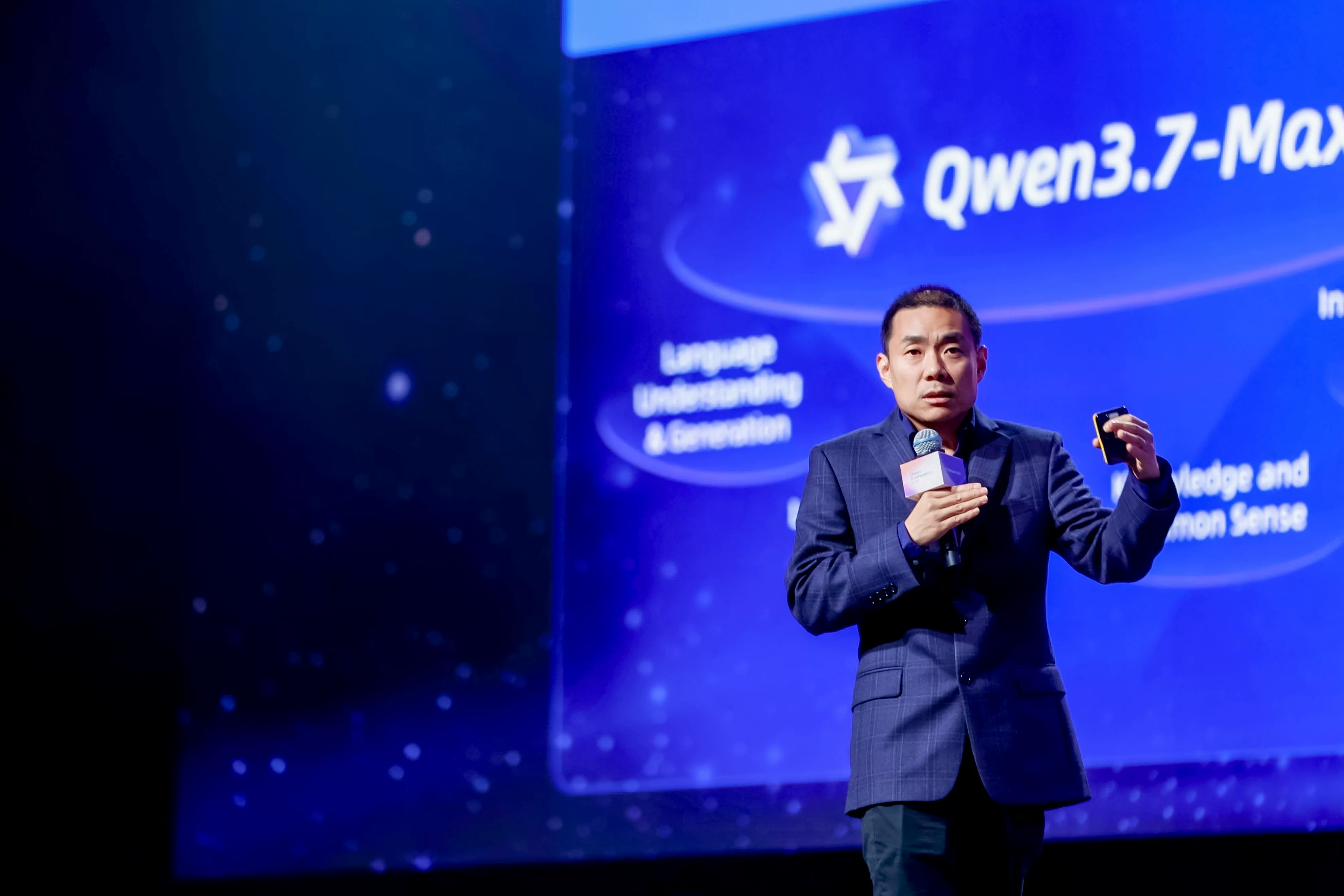
Alibaba Cloud, the digital technology and intelligence arm of Alibaba Group, has unveiled a suite of advanced AI models and platforms aimed at global customers, signaling a major push into the “agentic era” of artificial intelligence. The announcements were made at the company’s first international Qwen Conference in Singapore.
Quick Facts
- New Qwen3.7-Max LLM launched globally.
- Qwen Cloud, an AI-native platform, introduced.
- JVS Agent Suite released for enterprise agents.
Qwen3.7-Max Enters the Global Ring
Alibaba Cloud released its latest large language model, Qwen3.7-Max, making it available on its AI development platform, Model Studio. According to the Artificial Analysis global LLM Intelligence Index, the model ranked fifth globally and first among Chinese models, demonstrating performance competitive with leading international models from OpenAI, Anthropic, and Google.
With a score of 56.6 points, it surpassed other major Chinese models, positioning it as a robust foundation for building sophisticated AI agents.
Building an AI-Native Cloud
To simplify the development process, the company launched Qwen Cloud, a new AI-native platform designed for businesses and developers to build AI-powered applications and agents. The platform integrates Alibaba’s proprietary Qwen models alongside popular open-source and third-party models for various tasks including text, vision, audio, and video.
To support the agentic framework, Alibaba Cloud also introduced a new Skills portal that converts over 60 cloud product capabilities into a format that AI agents can easily invoke. This is complemented by infrastructure upgrades like lightweight execution sandboxes and cross-task memory to better support agent runtime environments.
Relevance for the MENA Tech Scene
While the launch event took place in Singapore, these advancements are directly relevant to the MENA region’s rapidly growing tech ecosystem. With a significant presence, including data centers in the UAE, Alibaba Cloud provides the underlying infrastructure for numerous startups and enterprises across the Middle East. The availability of these powerful, agent-focused AI tools on a familiar platform gives MENA developers and businesses direct access to build and deploy sophisticated AI solutions locally, addressing regional market needs without relying solely on Western competitors. This move is set to fuel further AI innovation across sectors like fintech, e-commerce, and logistics in the GCC and beyond.
JVS Agent Suite for Enterprise Deployment
For corporate clients, Alibaba Cloud debuted the JVS Agent Suite, a set of toolkits for building and managing proprietary AI agents. The suite includes JVS Claw Teams, which supports secure 24/7 cloud operation and centralized management of an organization’s internal skills.
Another new product, JVS Mobile, is an enterprise-grade mobile automation platform powered by the Qwen model. It enables the creation of AI agents that can perform complex tasks across different mobile applications through autonomous thinking and multi-agent collaboration.
Fostering a Global AI Ecosystem
Beyond product releases, Alibaba Cloud announced its new status as a Platinum member of the PyTorch Foundation, aiming to contribute to the open-source AI community.
The company also launched a global hackathon for developers to build production-grade AI agents on Qwen Cloud and a short film competition with design platform Picsart, inviting creators to produce films using its video generation model, HappyHorse.
About Alibaba Cloud
Alibaba Cloud is a global leader in full-stack artificial intelligence services, offering state-of-the-art intelligent capabilities and a worldwide AI cloud computing network, providing developer-friendly AI services across the globe. Qwen (Chinese: Tongyi Qianwen) is a family of large language and multimodal AI models developed by Alibaba. Debuted in 2023, open-weight Qwen models are available to global developers via HuggingFace and ModelScope.
Source: Zawya