




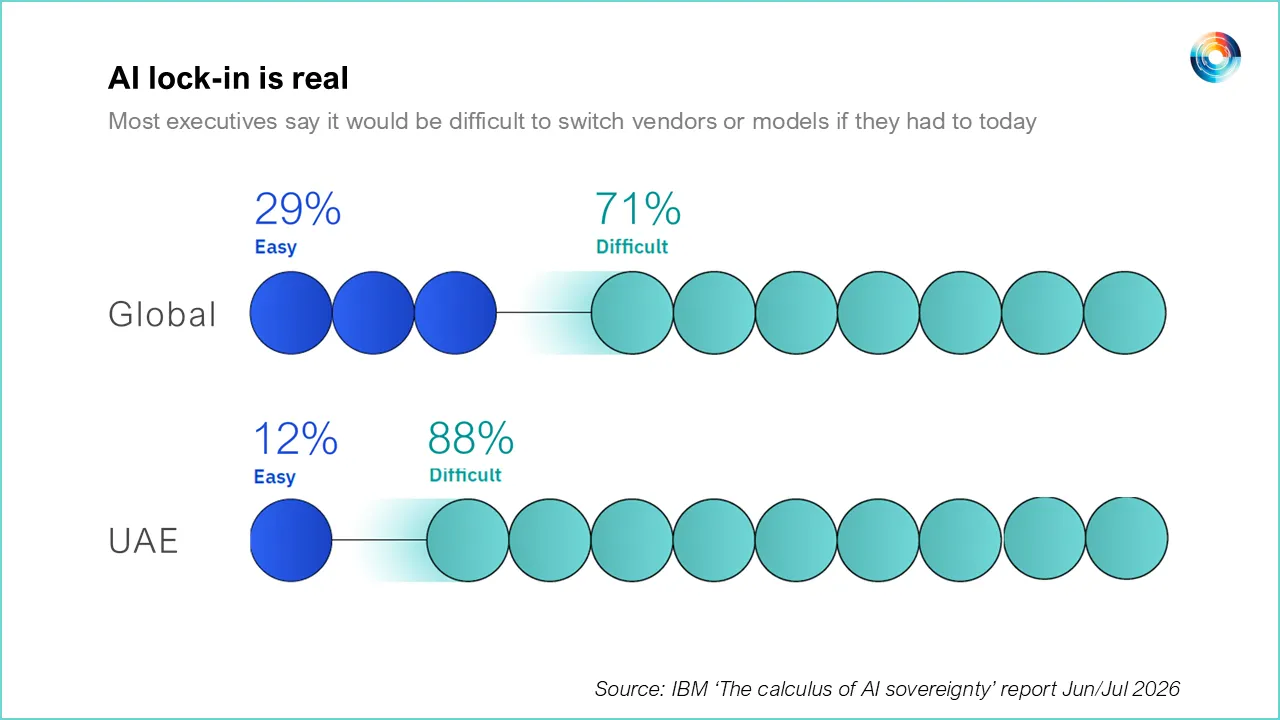
A new study by IBM reveals a critical dependency issue brewing within the UAE’s rapidly advancing tech sector. The report, titled “The Calculus of AI Sovereignty,” found that 88% of surveyed UAE executives believe switching their primary AI vendor would be difficult, exposing their operations to significant risk from vendor outages and a lack of strategic flexibility.
Quick Facts
- 88% of UAE firms find switching AI vendors difficult.
- 96% lack full understanding of their AI dependencies.
- 84% face severe disruption from a one-week vendor outage.
The Illusion of Control
While a majority of UAE organisations (82%) describe their AI environments as intentionally multi-vendor, the IBM data suggests this diversity is often accidental rather than a deliberate strategy. A staggering 96% of local executives admit they don’t fully understand their organisation’s dependencies across different AI vendors, models, and infrastructure.
This lack of clarity has real-world consequences. UAE organisations reported an average of seven AI-related disruptions over the past two years, slightly higher than the global average of six. With 84% of executives stating that a seven-day outage would cause severe or critical disruption, the financial and operational risks are substantial.
The High Cost of Switching
The study quantifies the scale of the lock-in challenge. For 80% of UAE executives, moving core AI systems to a new vendor would take at least six months. The data migration process alone is a major hurdle, with an estimated average of 150 days required to move AI training and operational data to a different environment.
This dependency has created a willingness to pay a premium for agility. The report found that 78% of UAE executives would accept a 20% cost increase to maintain their AI vendors if it guaranteed improved strategic flexibility, a figure higher than the 72% global average. The findings also highlight a challenge with data sovereignty, as 74% of local respondents find meeting residency requirements across different geographies to be a difficult task.
A Path to AI Sovereignty
Globally, the report notes that organisations with genuine control over their AI stack protect 55% more operating profit from AI-driven disruptions. However, only 7% currently operate at this advanced level.
To address this, IBM proposes a strategy of “selective AI sovereignty.” Instead of aiming for full control over every system, the firm recommends a tiered approach based on business risk. This involves investing heavily in flexibility for mission-critical platforms, such as fraud detection engines, while accepting a degree of vendor dependency for more commoditised tasks like transcription and translation, where the costs of switching are lower.
About IBM
International Business Machines Corporation (IBM) is a global technology company that provides hardware, software, cloud-based services, and cognitive computing. Founded in 1911, IBM is one of the world’s largest employers, with operations in over 175 countries, and is a major research organization.
Source: IBM Institute of Business Value