


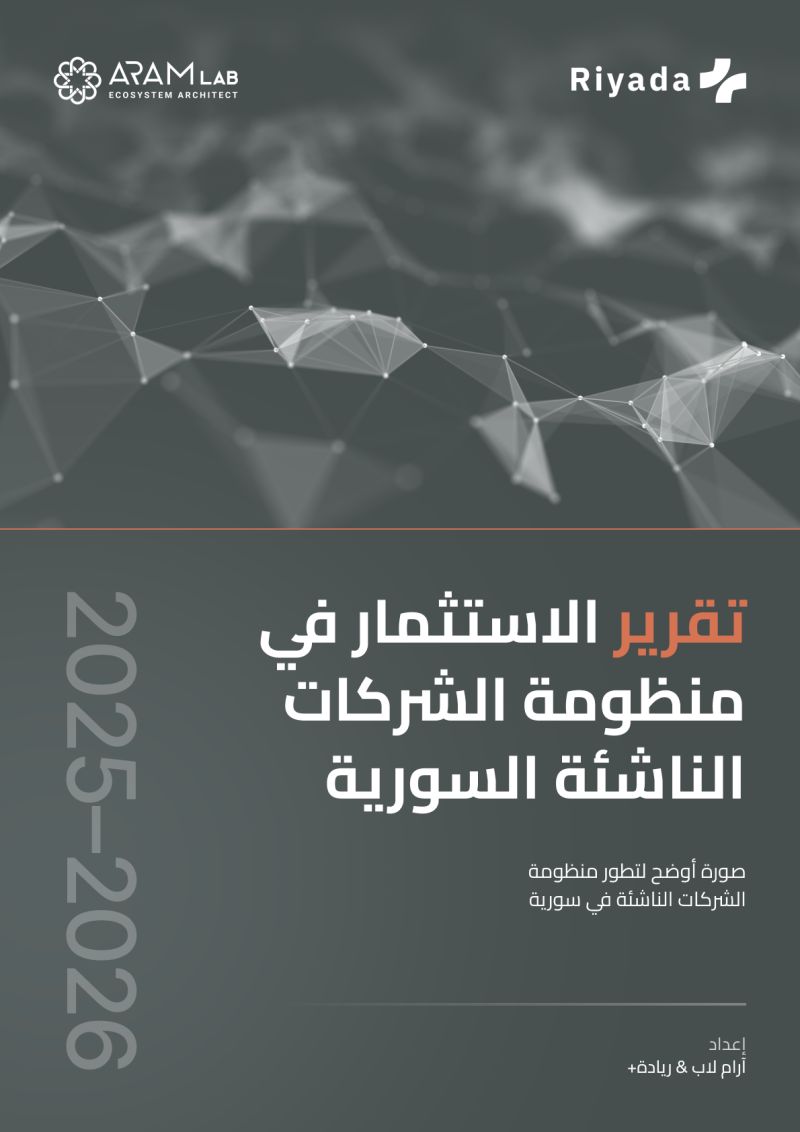
Aram Lab and Riyada+ identified $581,000 in verified startup investment across six deals with disclosed amounts in 2025–2026. The report highlights an early-stage funding market dominated by angel investors, alongside persistent legal, banking and infrastructure barriers
- Key findings at a glance
- Verified investment is concentrated in four sectors
- Angel investors are the main source of early capital
- Most recorded deals are still at pre-seed stage
- Syrian startups are increasingly cross-border businesses
- Legal and banking barriers complicate fundraising
- Talent, infrastructure and customer adoption remain constraints
- What investors look for in Syrian startups
- Five indicators to watch in 2027
- A baseline, not a verdict on the market
Syria’s startup ecosystem recorded 14 investment cases across nine sectors during 2025–2026, according to a new report by Aram Lab and Riyada+. The Syrian Startup Ecosystem Investment Report 2025–2026 documents $581,000 in verified investment across six deals with disclosed amounts, while finding that most of the recorded activity remains at the pre-seed stage and relies on individual angel investors and angel syndicates rather than venture capital funds.
The report, which brings together investment records, founder interviews and investor perspectives, provides a baseline for understanding the country’s emerging startup market. Its central finding is that entrepreneurial activity is advancing faster than the legal, financial and institutional systems needed to support sustainable company growth.
The authors caution that the figures are not a complete record of all startup investment in Syria. Many companies operate across multiple jurisdictions, funding terms are not always publicly disclosed, and some transactions take place through informal networks. The report therefore separates investment cases according to the strength of the available evidence rather than treating every reported deal as confirmed.
Key findings at a glance
| Indicator | Report finding |
|---|---|
| Investment cases identified | 14 |
| Sectors represented | 9 |
| Verified investment capital | $581,000 across six deals with disclosed amounts |
| Separately confirmed capital | $240,000 across two deals with disclosed amounts |
| Additional media-reported investment | $10 million, not independently confirmed |
| Deals at pre-seed stage | 13 of 14 |
| Recorded rounds led by venture capital funds | 0 |
The $581,000 figure represents investment classified at the report’s highest evidence level. The additional $240,000 in confirmed transactions and the $10 million media-reported round are presented separately and should not be added to the verified total as though they had the same evidentiary status.
Verified investment is concentrated in four sectors
Although the report identified investment activity across nine sectors, the disclosed amounts classified as verified were concentrated in health technology, agricultural technology, classified advertising and financial technology.
Health technology accounted for the largest share of verified capital, with $231,000 across three investment cases. Agricultural technology followed with $200,000, while two classified-advertising companies received a combined $100,000. Financial technology accounted for a further $50,000.
Verified investment by sector
| Sector | Investment cases | Verified capital | Share of verified capital |
|---|---|---|---|
| Health technology | 3 | $231,000 | 39.8% |
| Agricultural technology | 1 | $200,000 | 34.4% |
| Classified advertising | 2 | $100,000 | 17.2% |
| Financial technology | 1 | $50,000 | 8.6% |
| Total | 7 sector entries | $581,000 | 100% |
Note: The sector counts above reflect the cases and amounts reported in the sector breakdown. The verified-capital total covers six deals with disclosed amounts; some sector entries include cases for which no verified amount was disclosed.
The wider dataset also includes e-commerce, education technology, real estate technology, startup consulting and a super-app category. The absence of verified capital in the sector table does not mean these sectors received no investment. It means the report did not establish an amount that could be included in its verified-capital calculations.
The distribution illustrates both the variety of businesses attracting early backing and the limits of the available data. With amounts undisclosed for five of the 14 investment cases, a full comparison of funding by sector remains difficult.
Angel investors are the main source of early capital
The report found that angel investors and angel-investor syndicates account for most of the identifiable funding activity. No venture capital fund led any of the 14 recorded rounds, while the investor type was unavailable in three cases.
Angel syndicates supplied $565,000, or approximately 97.2% of the $581,000 in verified capital. An individual angel investor accounted for the remaining $16,000.
This pattern points to a market where early funding depends heavily on personal relationships and investors willing to take risks before companies have reached more established stages of growth. Syndicates also allow several angel investors to combine capital, making larger early-stage investments possible than individual investors might make alone.
The report describes these investors as providing more than money. Founders highlighted the value of strategic guidance, introductions to customers and partners, technical advice, governance support and help preparing for subsequent fundraising. In some cases, investors became ongoing advisers or partners in building the business.
That additional support can be particularly important when startups are operating in an environment where formal financing channels and specialist support structures remain limited.
Most recorded deals are still at pre-seed stage
Thirteen of the 14 investment cases were classified as pre-seed, placing the recorded activity firmly at the earliest stage of company development.
At this stage, founders are often still testing their business models, demonstrating demand and building the first versions of their products. Investors interviewed for the report said they placed significant weight on the founding team, execution, market understanding and evidence of actual customer demand.
A working minimum viable product, real transactions and early user activity could carry more weight than a polished pitch or an ambitious market-size estimate. In one example discussed in the report, the investor’s own experience using a startup’s product helped lead to an investment decision.
The findings suggest that startups seeking funding need to demonstrate not only that a problem exists, but also that customers are willing and able to use or pay for a solution. This is especially relevant in a market where reliable commercial data can be difficult to obtain and digital adoption varies between customer groups.
The report also notes that fundraising can be a lengthy process. Founders may need to build relationships with investors while simultaneously managing product development, sales, hiring and daily operations. A delay in closing a round can therefore create operational risks, particularly for small teams with limited financial runway.
Syrian startups are increasingly cross-border businesses
One of the report’s most important findings is that Syria’s startup ecosystem cannot be understood solely through companies legally registered inside the country.
Founders, employees, customers and investors may be spread across Syria, Türkiye, Europe and the Gulf, as well as wider Syrian diaspora networks. A startup might maintain an operational team in Syria, serve customers in several markets and receive investment through a legal entity registered abroad.
The report’s broader ecosystem mapping therefore uses a wider definition of a Syrian startup, based on meaningful connections through its founders, team, operations, market or contribution to Syrian entrepreneurial capacity. It distinguishes this wider mapping from the narrower dataset used to analyse investment deals.
Among the funded companies examined in the report, most maintained or were developing part of their legal structure outside Syria, while another was considering that option. Such arrangements can help startups access investors, banking services and investment instruments that are difficult to use domestically.
However, they also add complexity. Companies may have to manage entities in several jurisdictions, separate the location of their operations from the location of their legal registration, and navigate different requirements for ownership, payments and compliance.
The result is an ecosystem that is both local and international, but not always well served by systems designed around a company operating and registering in one country.
Legal and banking barriers complicate fundraising
The report identifies financial integration as a major constraint on startup growth. Companies need to receive customer payments, pay employees and suppliers, maintain auditable accounts, receive grants or investment, access software and cloud services, and demonstrate compliance to financial institutions.
These functions can be difficult to manage when banking relationships, cross-border transfers and suitable legal instruments are limited.
The report’s deal records show how startups have adapted. Some use foreign holding companies, while others rely on agreements designed to accommodate gaps in the local legal framework. For example, SAFE agreements, commonly used in startup financing, are not recognised in Syrian law in the same way they are in some other jurisdictions. Founders have therefore used alternative contractual arrangements or converted agreements into equity after registering companies abroad.
Cross-border transfers can also involve additional costs and documentation challenges. Founders and investors described cases in which money moved through informal channels or intermediaries, making it harder to document transactions and complete standard due diligence.
These workarounds can help individual companies close rounds, but they do not replace predictable legal structures and accessible financial services for the wider market.
The report argues that improved banking access and clearer rules for startup financing would help make investment more repeatable. It also highlights the importance of reliable payment systems and stronger connections between banks and financial technology companies.
Talent, infrastructure and customer adoption remain constraints
The barriers extend beyond fundraising. Founders described challenges involving internet reliability, electricity, recruitment and retaining skilled employees. Local startups can struggle to compete with regional employers offering higher salaries, while unreliable infrastructure adds friction to product development and day-to-day operations.
Low levels of digital adoption create a more complicated picture. Underserved markets can offer opportunities for companies introducing digital services, but founders may need to spend considerable time building customer trust, explaining new products and changing established habits.
The report also points to a gap between founder ambition and the readiness of the surrounding ecosystem. Some startups seek regional expansion early because local purchasing power is limited, yet the legal, financial and operational systems needed to support that expansion are not always sufficiently developed.
For investors, this increases the importance of local knowledge and trusted relationships. Several interviewed investors described relying on founder networks, direct conversations, referrals, professional events and community channels to discover companies and assess opportunities. Founders without access to those networks can face additional difficulty getting their businesses in front of investors.
What investors look for in Syrian startups
The report’s interviews point to a set of recurring considerations shaping investment decisions.
- The founding team: Investors assess founders’ skills, commitment, ability to execute and capacity to adapt to difficult operating conditions
- Evidence of demand: Real users, early sales, transactions and product testing help demonstrate that a startup is addressing a genuine need
- Market understanding: Reliable local knowledge is important where formal market data is limited
- A credible route to revenue: Investors look for realistic financial plans and a path towards sustainable commercial activity
- Transparency and trust: Clear communication, verifiable information and credible local relationships help reduce uncertainty
- Regional potential: Some investors favour businesses that solve a local problem while retaining the ability to expand into neighbouring or international markets
The report also highlights the value of investors who can connect founders with customers, partners and future funding sources. For early-stage companies, this support can be as important as the initial investment itself.
Five indicators to watch in 2027
Rather than predicting a single outcome for Syria’s startup ecosystem, the report identifies several developments that could help determine whether recent activity becomes more sustainable.
| Indicator | What to watch |
|---|---|
| Banking reintegration | Whether improved international banking connections translate into reliable payments and repeatable cross-border transactions for startups |
| National startup agenda | Whether the national agenda for technology startups moves from policy announcements to implementation, with clear and transparent selection and support mechanisms |
| Regional investment | Whether interest from Gulf investors and the Syrian diaspora develops into a repeatable funding channel rather than isolated deals |
| Talent and diaspora engagement | Whether more formal pathways emerge for diaspora professionals to mentor, invest in, work with or return to Syrian startups |
| Better ecosystem data | Whether future reporting captures more deals, verifies a higher share of them and reduces the gap between public disclosures and actual investment activity |
The report stresses that progress in one area alone will not necessarily resolve the ecosystem’s wider challenges. For example, access to international banking systems does not automatically mean that startups can reliably receive investor transfers or payments from overseas customers. Similarly, a publicised investment transaction is a positive signal, but not proof that a repeatable financing market has emerged.
A baseline, not a verdict on the market
The Syrian Startup Ecosystem Investment Report 2025–2026 documents a market where investment is taking place, but where much of the activity remains early-stage, relationship-driven and difficult to measure comprehensively.
Its 14 recorded cases show founders attracting capital across a range of sectors, often by combining local market knowledge with regional networks and legal structures outside Syria. At the same time, the concentration of verified funding among angel investors, the absence of VC-led rounds and the prevalence of pre-seed deals point to a financing market that is still developing.
For the report’s authors, the next question is not simply whether the number of startups or publicised investment announcements increases. It is whether companies can access banking and payment services more reliably, operate under clearer legal arrangements, retain talent, attract repeat investment and move from early experiments towards sustainable growth.
The authors intend the report to serve as a baseline for founders, investors, policymakers and ecosystem-support organisations, with future editions helping track whether the infrastructure surrounding Syrian startups is catching up with the activity already taking place.
Read the full report: Syrian Startup Ecosystem Investment Report 2025–2026
Source: Aram Lab and Riyada+