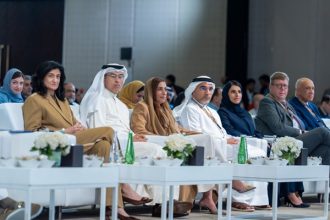





The 9th Annual Angel Rising Investor Symposium, organized by startAD, the Abu Dhabi-based global accelerator, and VentureSouq, recently concluded at Abu Dhabi Global Market (ADGM). Held in partnership with the Environment Agency – Abu Dhabi (EAD), the event convened over 150 investors, policymakers, and climate innovators to address the urgent theme of “Scaling Climate Resilience in the Global South.”
Bridging the Climate Investment Gap
A central theme of the symposium was the significant disparity in climate-tech funding for the MENA region. The event highlighted a critical innovation gap, where groundbreaking ideas often lack the necessary capital to scale and create impact.
In her keynote address, H.E. Shaikha Mohamed Al Mazrouei, Executive Director of the Integrated Environmental Policy and Planning Sector at EAD, emphasized this challenge. “Today, the MENA region remains a very small recipient of climate-tech capital. In fact, Middle East investors direct less than 2 percent of their global climate-tech investment into companies
based in the region,” she stated. “Most of this limited funding goes toward mitigation, while adaptation, despite the region’s high vulnerability, receives only a marginal share. If we are serious about advancing climate resilience, we must close that gap.”
A Trillion-Dollar Opportunity
The symposium framed the climate transition not just as an environmental imperative but as a major economic opportunity. Speakers underscored the need to accelerate investment into climate-exposed regions to unlock the next wave of sustainable growth.
Nihal Shaikh, Associate Director of startAD, commented, “Communities across the Global South bear the most significant burden of climate impacts and face projected GDP losses of up to 64 percent by the end of this century. Accelerating ClimateTech investment is not only essential for the planet, it is an economic and social necessity.” She added, “The climate transition represents a trillion-dollar growth opportunity.”
Fostering a Collaborative Ecosystem
The event showcased the power of collaboration between venture capital, policymakers, and corporate innovators. Discussions explored how blended finance, regulatory frameworks, and emerging technologies like AI can de-risk early-stage investments and accelerate climate solutions.
Sonia Weymuller, Co-Founder and General Partner at VentureSouq, noted the solutions-driven dialogue. “The symposium showcased the quality and diversity of thought leadership emerging from this region. What stood out was a shared recognition that building climate resilience in the Global South requires an inclusive investment approach – one that combines early-stage capital with long-term policy commitment.”
Panel discussions covered topics such as leveraging technology for climate adaptation, integrating AI to supercharge climate modeling, and creating enabling policies to drive innovation. The symposium builds on the legacy of COP28, reinforcing the UAE’s role as a bridge between global finance and local innovation.
About startAD
startAD is an Abu Dhabi-based accelerator, steering local and global startups to scale in the UAE and beyond. Powered by Tamkeen and anchored at NYU Abu Dhabi, startAD is a new model for innovation that creates customized and impact-driven programs in partnership with stakeholders including governments, corporations, investors, and innovation entities, furthering the UAE’s transition into a knowledge-based economy.
About VentureSouq
VentureSouq (VSQ) is a leading MENA-based venture capital firm with a global portfolio of 300+ companies. VSQ has established itself as a pioneering force in technology investments in MENA and beyond, with dedicated investment vehicles across Climate and FinTech. Through its thematic investment approach, VSQ has built a strong track record in identifying, investing in, and scaling breakthrough technologies.
About Environment Agency – Abu Dhabi (EAD)
Established in 1996, the Environment Agency – Abu Dhabi (EAD) is committed to protecting and enhancing air quality, groundwater, as well as the biodiversity of the desert and marine ecosystem. By partnering with government entities, the private sector, NGOs, and global environmental agencies, it embraces international best practices and innovation to institute effective policy measures and raise environmental awareness.
Source: Zawya