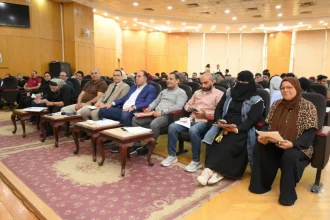



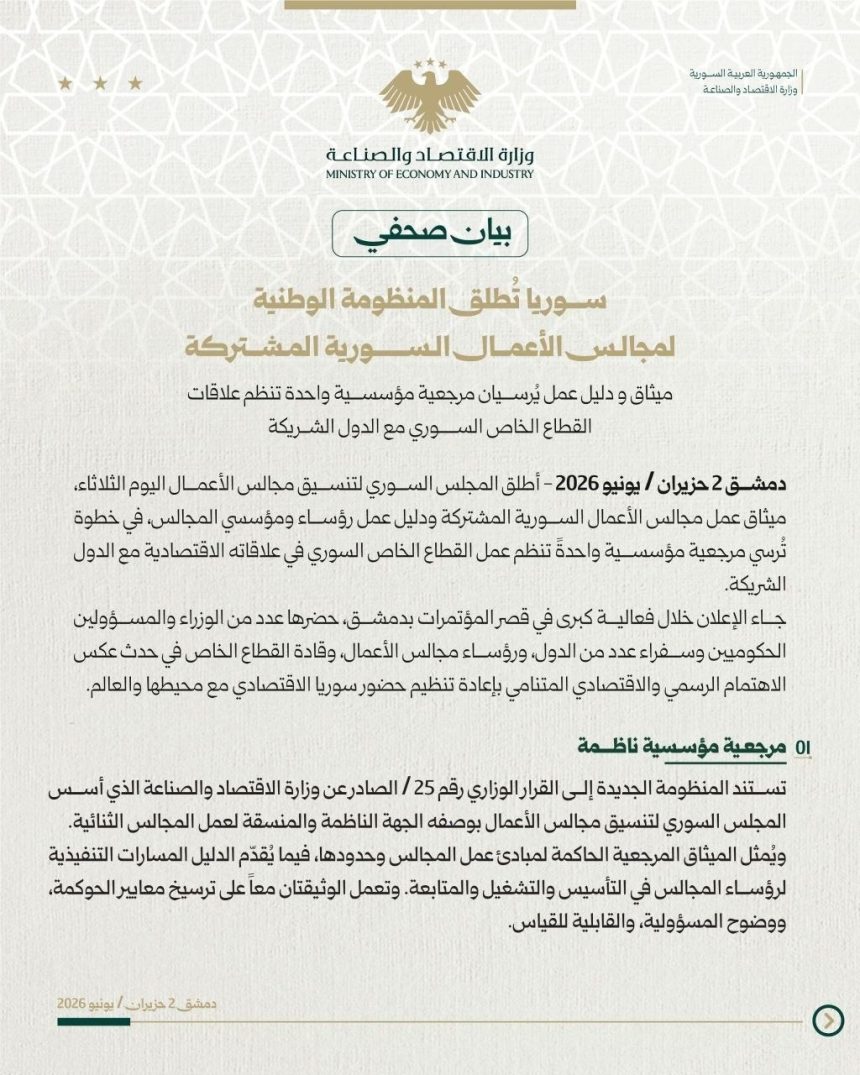
Syria’s Ministry of Economy and Industry, in collaboration with the United Nations Development Programme (UNDP), has officially introduced the Business Councils Charter during the landmark Syrian Private Sector Dialogue conference held at the Conference Palace in Damascus. Announced on June 2, 2026, the newly unveiled regulatory framework establishes a unified institutional architecture to govern joint Syrian business councils, moving private-sector engagement from fragmented relations into a structured, accountable, and scalable system. The initiative marks a defining step in the country’s broader localization strategy, aiming to align private enterprise activities directly with state economic recovery programs.
Architectural Reconstruction of Public Private Engagement
The rollout of the Business Councils Charter represents a shift toward governance and measurable performance metrics in Syria’s commercial landscape. Backed by Ministerial Decree No. 25, the framework establishes the Syrian Council for Coordinating Business Councils as the primary regulatory and coordinating organ. According to Dr. Nidal Al-Shaar, the Minister of Economy and Industry, the implementation of this charter acts as a structural foundation for the state to build more mature and organized economic tools, shifting away from temporary solutions to steady institutional pathways.
By unifying corporate and entrepreneurial representation under an integrated system, the ministry intends to streamline how the local private sector interacts with government ministries, international development agencies, and foreign investment bodies. Rawad Ramadan, President of the Syrian Business Councils Board, noted that establishing a single, cohesive voice allows the domestic business ecosystem to build measurable, credible relationships with international partner countries.
Three Tier Multi Stakeholder Ecosystem Structure
The new framework reorganizes private sector engagement into three clear operational levels designed to balance localized enterprise demands with macroeconomic international priorities:
- Bilateral Councils: Serving as the foundational economic units, these groups manage targeted financial and commercial relationships with specific partner states.
- Joint Action Groups: Regional clusters operating under wider geographic frameworks to harmonize trade logistics and investment protocols across cross-border markets.
- Sectoral Councils: Horizontally structured boards comprised of technical committee chairs who align production requirements, labor skillsets, and digital transitions across high-priority industries.
To ensure active oversight and prevent these councils from becoming purely symbolic entities, the program integrates digital support infrastructure. This includes a unified national business platform, centralized membership databases, and a strict matrix of Key Performance Indicators (KPIs) to measure actual economic output, transparency, and corporate compliance.
Four Pillars for Strategic Economic Realignment
The institutionalization of these business councils aims to directly address the economic constraints highlighted by delegates during the broader three-day national conference. The Ministry of Economy and Industry has designated four primary strategic mandates for the restructured councils to tackle:
- Expanding National Export Capacity: Restoring shattered value chains and standardizing quality infrastructure to help Syrian products re-enter regional and global markets.
- Attracting Foreign and Domestic Capital: Leveraging the provisions of the new Investment Law No. 114 to streamline regulatory approvals and secure investments for industrial sectors.
- Securing Cross Border Corporate Opportunities: Creating reliable matchmaking networks, joint ventures, and franchising models for local small and medium enterprises (MSMEs).
- Elevating Private Sector Operational Efficiency: Modernizing internal technical capacity, backing digital innovation networks, and integrating youth and women-led enterprises into the formal economy.
About Syrian Private Sector Dialogue
The Syrian Private Sector Dialogue is a flagship national platform led by the United Nations Development Programme (UNDP), with key financial support from the Government of Japan, designed to foster evidence-based economic recovery and public-private policy formulation. Operating since 2018 as a neutral vehicle to build consensus among domestic enterprises, regional chambers, and the global diaspora, the initiative focuses on removing structural regulatory barriers, enhancing credit access for MSMEs, and designing sustainable transition pathways for the local economy.
Source: UNDP