



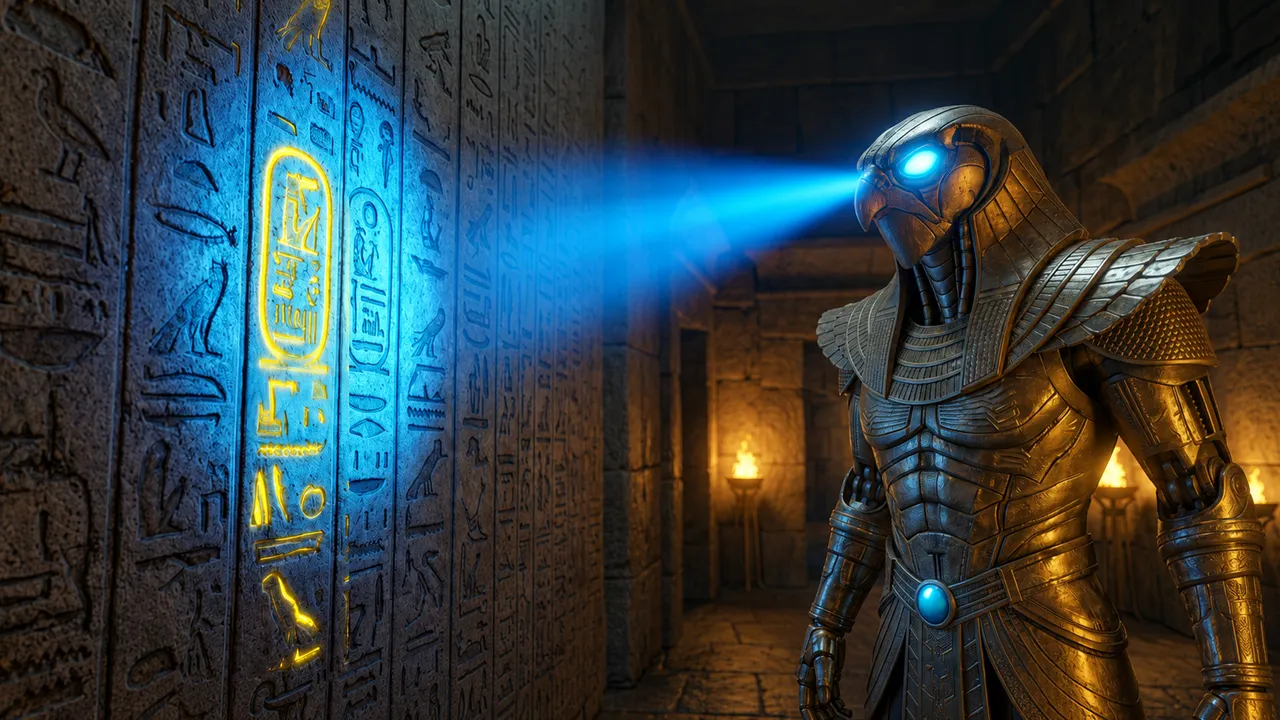
Alexandria-based AI startup TokenAI has launched Horus Hiero and Horus Hiero Mini, two multimodal foundation models designed to read, translate, and reason across Ancient Egyptian hieroglyphics, modern Arabic dialects, and over 100 other languages. Developed entirely without external funding, the models are the first in the Arab world to feature a native hieroglyphic processing engine, enabling direct visual translation from ancient artifacts.
Quick Facts
- Two new models: Horus Hiero 9B and Horus Hiero Mini 4B.
- First AI with native hieroglyphic visual translation engine.
- Developed by Egyptian startup TokenAI without external funding.
From Papyrus to Pixels
Unlike existing vision models that can only identify hieroglyphic symbols, the Horus Hiero models can parse ancient grammar and produce structured translations directly from visual inputs. The core of this capability is a native processing engine trained on epigraphic drawings, stone reliefs, and papyrus documents. This allows the AI to translate ancient inscriptions into English and Arabic without needing separate, external vision tools.
Both Horus Hiero models are being released as open-weight under a custom developer licence to encourage research, with a Horus Chat web and mobile interface expected to follow. Potential applications range from real-time translation apps for tourists in museums to advanced Egyptology research tools and high-fidelity OCR for historical archives.
Benchmarking an Ancient Language
To accurately measure the models’ performance, TokenAI created its own Hieroglyphic AI Benchmark, which assesses recognition, transliteration, translation, and contextual reasoning. The flagship Horus Hiero 9B model achieved an overall score of 90% on this benchmark, including 92.4% on visual symbol recognition and 89.3% on grammatical translation.
The smaller Horus Hiero Mini 4B model scored 84.2% on the same tests. It is optimized to run on standard CPUs and mobile devices, making offline, real-time hieroglyphic translation possible on budget hardware.
Competitive General Performance
Beyond its historical language skills, Horus Hiero is a powerful general-purpose model. It features a 128K token context window, large enough to process entire books in a single pass, and supports over 100 languages with full dialect mapping for colloquial Egyptian, Levantine, Gulf, and North African Arabic.
According to TokenAI’s internal evaluations, the models hold their own against global competitors. The 9B model scored 79.3% on MMLU-Pro and 78.1% on GPQA Diamond, competitive figures for its size. The 4B Mini model also posted strong results, scoring 74.2% on MMLU-Pro, demonstrating robust reasoning capabilities within a compact package.
This launch follows the company’s release of Horus 1.0-4B in April, a model that outperformed larger models like Meta’s Llama 3.1-8B and Google’s Gemma-2-9B on the MMLU benchmark.
About TokenAI
Founded by Egyptian entrepreneur Assem Sabry, TokenAI is an Alexandria-based artificial intelligence startup. The company focuses on developing powerful and efficient foundation models optimized for the cultural heritage, languages, and dialects of the Middle East and North Africa region.
Source: Middle East AI News